Why would a candle flame become a blue sphere instead of a flickering yellow teardrop in microgravity
Strip away gravity, and fire sheds its flickering yellow cloak to become a haunting, motionless orb of sapphire light. Discover the otherworldly science that transforms a simple candle flame into a perfect, ghostly sphere in the depths of space.

Too Long; Didn't Read
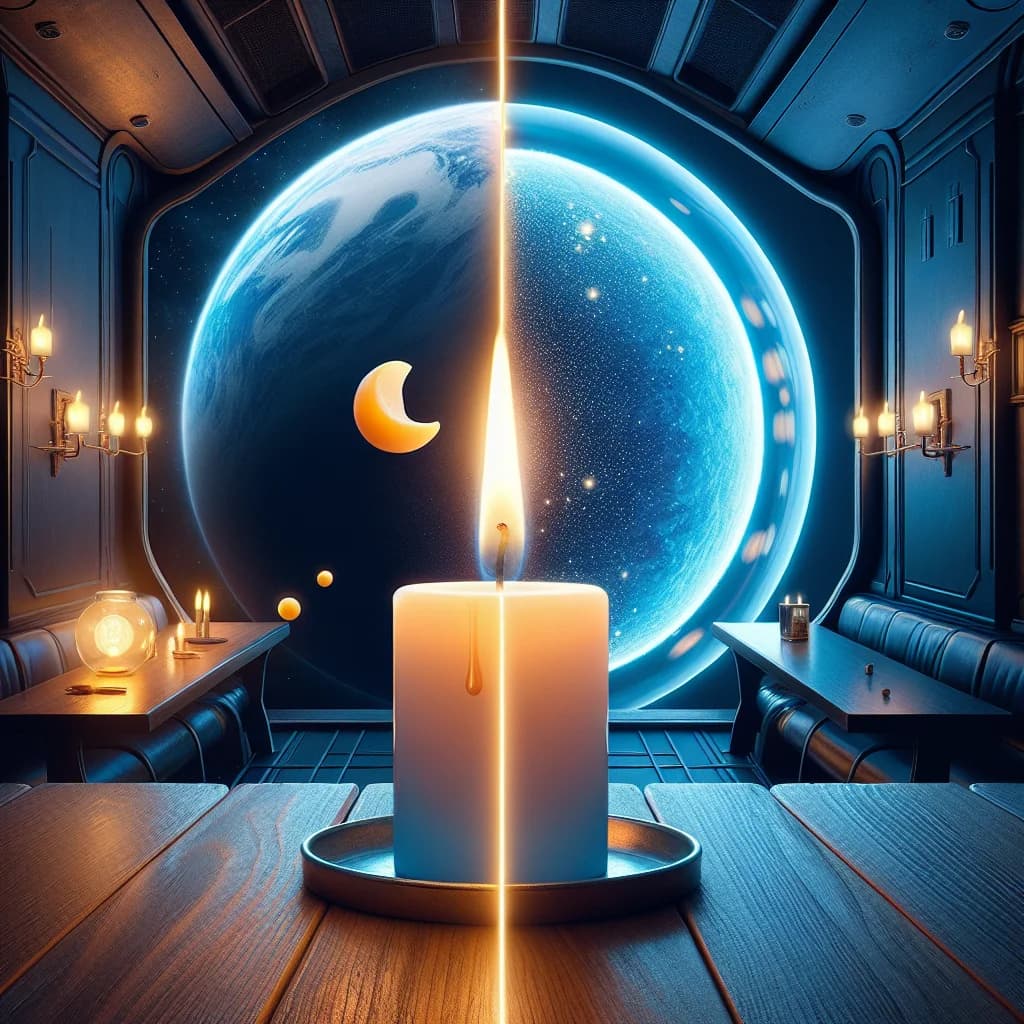
Without gravity, buoyancy-driven convection ceases, meaning hot air no longer rises to form a teardrop. Instead, oxygen reaches the flame through uniform diffusion from all directions, creating a stable blue sphere where combustion is more efficient and produces less soot.
The Mystery of the Blue Orb: Why Does a Candle Flame Become a Spherical Ghost in Microgravity?
Imagine striking a match aboard the International Space Station. Instead of the familiar, dancing yellow teardrop that has illuminated human history for millennia, you are greeted by something hauntingly alien: a tiny, translucent blue sphere hovering motionless above the wick. This isn't science fiction; it is a fundamental shift in how the universe handles energy when gravity is removed from the equation. To understand why fire "rounds bases" in space, we must dive into the worlds of fluid dynamics, thermodynamics, and molecular chemistry to see how a simple candle behaves when it is no longer being "pulled" by the Earth.
The Gravity of the Situation: Why Earthly Flames Flicker
To understand the sphere, we must first understand the teardrop. On Earth, gravity is the primary architect of a flame's shape through a process called buoyancy-driven convection.
When you light a candle on the ground, the flame heats the surrounding air. As this air gets hot, it expands and becomes less dense than the cool air around it. Gravity pulls the heavier, cooler air downward, which pushes the lighter, hot air upward. This creates a constant "conveyor belt" of gas:
- The Updraft: Hot gases and soot rise rapidly, stretching the flame into its iconic pointed shape.
- The Fresh Intake: As the hot air rises, it sucks in a fresh supply of oxygen from the bottom to keep the chemical reaction going.
- The Flicker: This turbulent rush of air is what causes a candle to dance and flicker.
Life Without Up: The Rise of Molecular Diffusion
In the microgravity environment of orbit, the concept of "up" and "down" effectively vanishes. Because there is no significant gravitational pull to distinguish between heavy cold air and light hot air, buoyancy-driven convection stops entirely.
Without convection, the "conveyor belt" of oxygen breaks down. Instead, the flame must rely on a much slower process called molecular diffusion. In this scenario, oxygen molecules and fuel vapors move via random collisions, slowly drifting toward one another. Because the gas isn't being pushed upward, it expands outward equally in every direction from the wick. This creates a perfect mathematical sphere—the most efficient shape for a gas expanding in a vacuum-like state of equilibrium.
The Chemistry of Color: Why the Yellow Disappears
The most striking difference isn't just the shape, but the color. Earthly flames are famously yellow, while microgravity flames are a ghostly blue. This transition is a matter of "cleanliness" in combustion.
- Soot Production: In a standard teardrop flame, the convection current is so fast that the combustion is often "rich" and incomplete. This creates tiny clusters of unburnt carbon, or soot.
- Incandescence: These soot particles get so hot that they glow with a bright yellow light (incandescence), similar to the filament in an old lightbulb. This yellow glow is actually a sign of inefficient burning.
- Chemiluminescence: In space, the slow-motion nature of diffusion allows the fuel and oxygen to mix more thoroughly at the molecular level. Because the combustion is more efficient, soot is not produced. Without soot to glow yellow, we see the actual "true" color of the chemical reaction: a dim, sapphire blue caused by excited molecules releasing energy as light.
Assessing the Energy Output
While a space flame looks high-tech, it is actually much weaker than its Earthly counterpart. Because diffusion is a sluggish way to transport oxygen, the "burning" happens at a much lower intensity.
- Temperature: A candle on Earth burns at roughly 1,400°C (2,550°F). In microgravity, the spherical flame is often significantly cooler, sometimes struggling to maintain the heat necessary to keep the wax melting.
- Oxygen Consumption: Calculations show that a microgravity flame consumes oxygen at a rate nearly three times slower than a flame on Earth.
- Sustainability: Because the "exhaust" (carbon dioxide and water vapor) doesn't rise away, it tends to linger around the flame, eventually "smothering" it in its own waste gases unless there is a slight external airflow.
Conclusion
The transformation of a candle flame from a yellow teardrop to a blue sphere is a masterclass in how environment dictates physical laws. On Earth, gravity drives a chaotic, convective engine that creates the hot, bright, and pointed flames we use for warmth. In the stillness of microgravity, fire settles into a quiet, spherical equilibrium governed by the gentle drift of molecules.
By stripping away the "noise" of gravity, scientists can study the pure chemistry of combustion. These tiny blue marbles aren't just beautiful anomalies; they are the keys to developing ultra-efficient engines and better fire safety protocols for future explorers traveling to the stars. Fire, it seems, is a completely different beast once it leaves the nest of Earth’s gravity.