Why would a candle flame in microgravity be perfectly spherical and blue instead of flickering upward
Imagine a flame that doesn't flicker or rise, but glows as a hauntingly beautiful, perfect blue sphere. Step into the strange world of microgravity to discover how fire behaves when the rules of Earth are stripped away.

Too Long; Didn't Read
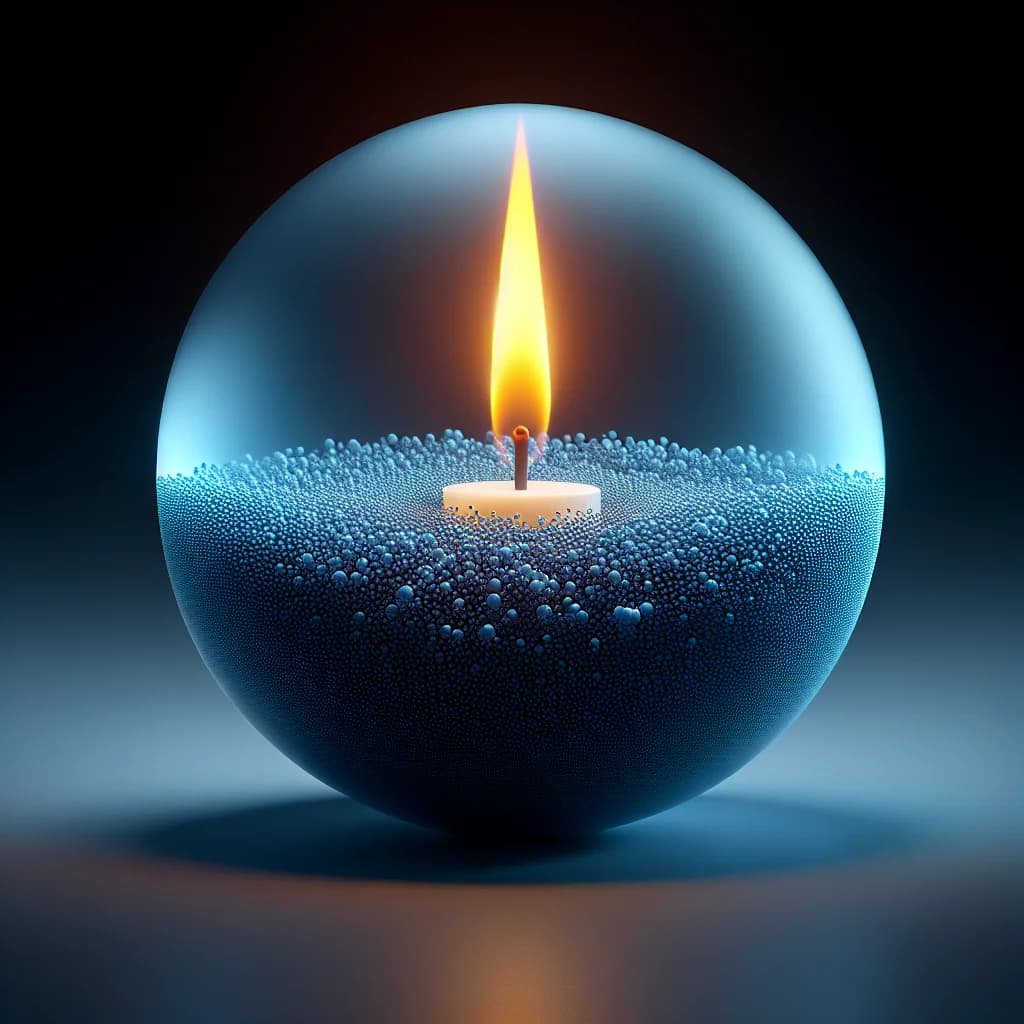
In microgravity, the absence of buoyancy prevents hot gases from rising, eliminating the traditional flickering teardrop shape. Instead, oxygen reaches the flame uniformly through diffusion from all directions, creating a spherical shape. The flame appears blue because combustion is more efficient and lacks the soot particles that normally glow yellow as they rise.
Why Is a Candle Flame in Microgravity a Blue Sphere? The Physics of Fire Without "Up"
Have you ever wondered what happens to the most basic of human tools—fire—when you strip away the one thing we take for granted every day? On Earth, a candle flame is a flickering, yellow teardrop, dancing and swaying with every breath of air. But aboard the International Space Station, fire undergoes a surreal transformation. Instead of a tall, pointed light, you get a tiny, eerie, and perfectly spherical blue orb that looks more like a ghost than a hearth.
This dramatic shift isn't just a visual quirk; it is a profound demonstration of fluid dynamics and thermodynamics. To understand why fire loses its "teardrop" and its "yellow," we must look at the foundational battle between buoyancy-driven convection and molecular diffusion. By analyzing how gases behave when gravity is removed from the equation, we can uncover the elegant physics that govern combustion in the cosmos.
The Downfall of "Up": Goodbye, Buoyancy
To understand a space flame, we first have to understand why an Earth flame looks the way it does. On Earth, gravity is the architect of fire. When you light a candle, the flame heats the surrounding air. This hot air becomes less dense than the cool air around it. Because of gravity, the cooler, denser air sinks, pushing the hot air—and the flame—upward.
This process is called buoyancy-driven convection. It creates a constant "conveyor belt" of air:
- Fresh oxygen is pulled into the bottom of the flame.
- Hot combustion products (CO2 and water vapor) are swept upward.
- This upward rush stretches the flame into its familiar elongated shape.
In microgravity, this conveyor belt breaks. Without gravity to pull denser air down, there is no "up" for the hot air to go. The air doesn't rise; it simply sits there.
The Geometry of Diffusion
Without convection to move gases around, a new physical law takes the lead: molecular diffusion. In this state, oxygen molecules and fuel vapors move from areas of high concentration to low concentration through random molecular collisions.
Because there is no directional force (like buoyancy) pushing the gases in one direction, the diffusion happens equally in every direction—360 degrees of movement. Mathematically, the path of least resistance from a central point (the wick) creates a perfect sphere. The flame becomes a stable, translucent globe where the fuel and oxygen meet at a specific, uniform distance from the center.
Why the Blue Hue? The Chemistry of "Cool" Fire
The most striking difference is the color. Earth flames are famously yellow, while microgravity flames are a deep, ghostly blue. This change is all about soot.
On Earth, the convection current is so fast that the combustion process is often "messy." Carbon atoms cluster together to form tiny particles of soot. These soot particles get pushed upward and heated until they glow—a process called incandescence. This creates the bright yellow light we associate with candles.
In microgravity, the burn is much slower and more efficient. Because the oxygen moves slowly via diffusion, the "burning zone" is much leaner.
- Soot Reduction: Studies show that microgravity flames produce significantly less soot (often near zero) because the carbon has more time to react completely with oxygen.
- Chemiluminescence: Without glowing soot to mask it, we see the natural light of the chemical reaction. This is called chemiluminescence, specifically from excited CH and C2 radicals, which emit light in the blue spectrum.
A Slower, Steadier Burn
If you were to measure the energy output, you would find that a microgravity flame is actually "cooler" than its Earth-bound cousin. On Earth, a candle might burn at roughly 1,400°C (2,552°F). In space, the lack of a constant fresh oxygen "wind" means the flame burns at a lower temperature and at a much slower rate.
While an Earth candle might consume its wax at a steady clip, a spherical space flame lingers, sipping oxygen at a leisurely pace. In fact, if the sphere grows too large, it can actually "suffocate" on its own exhaust gases (CO2) because they can't float away, eventually leading to the flame extinguishing itself unless there is a slight mechanical airflow.
Conclusion
The transformation of a candle flame from a yellow flicker to a blue sphere is a masterclass in the laws of motion and thermodynamics. It proves that what we consider the "natural" behavior of fire is actually a partnership between chemistry and gravity. By removing buoyancy, we reveal the quiet, radial symmetry of diffusion and the pure blue light of efficient combustion.
Beyond being a beautiful visual experiment, studying these tiny blue orbs helps scientists develop better fire-suppression systems for spacecraft and more efficient internal combustion engines for cars on Earth. It turns out that by taking gravity away, we can see the inner workings of fire more clearly than ever before.