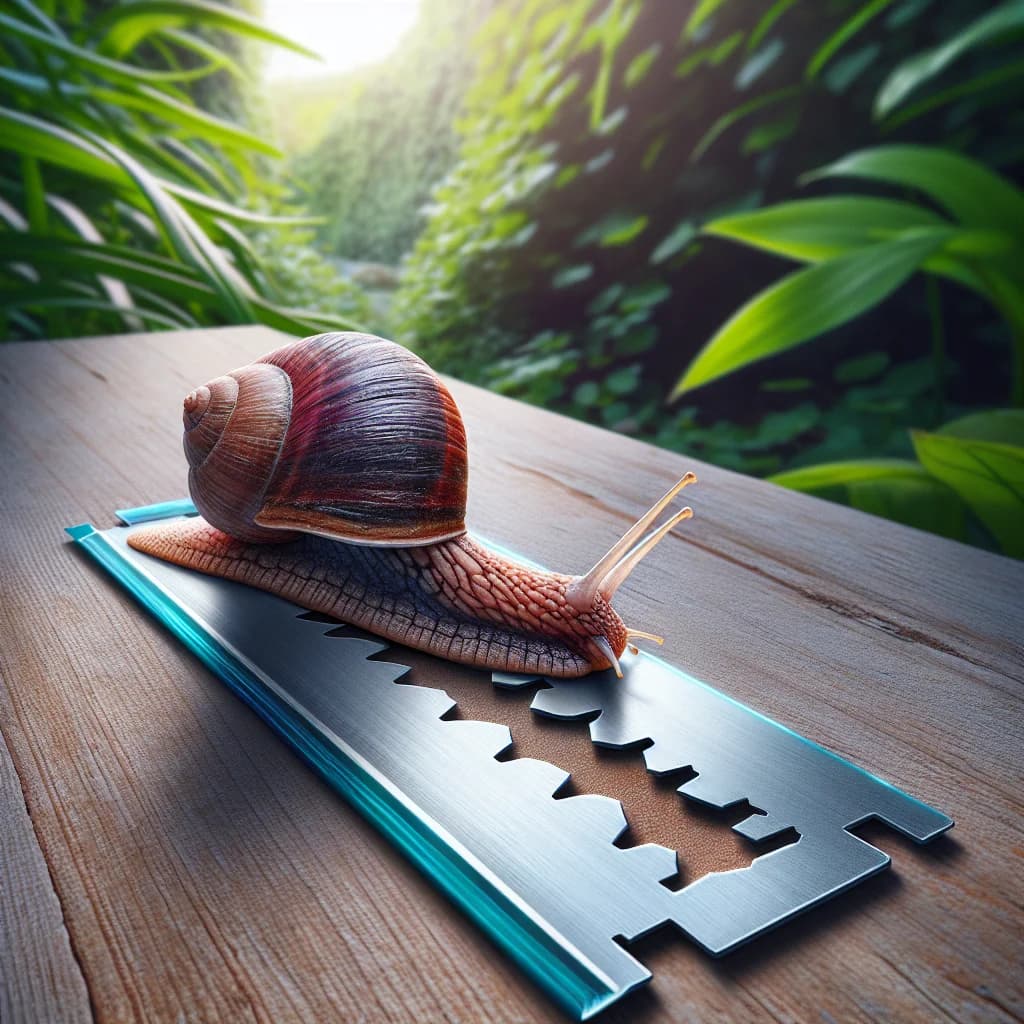
Why would a garden snail be able to crawl over a sharp razor blade without getting cut
Imagine gliding across the edge of a lethal blade without a single scratch—nature’s softest creature does it every day. Discover the mind-bending biological "superpower" that allows a humble snail to turn a deadly razor into a harmless path.

Too Long; Didn't Read
Snails produce a thick layer of protective mucus that acts as a lubricant and cushion. This slime creates a physical barrier between their soft bodies and the sharp edge, while simultaneously distributing their weight to prevent the blade from piercing their skin.
Slime, Surface Tension, and Superpowers: How Can a Snail Traverse a Razor’s Edge Unharmed?
Imagine a creature so delicate that a few minutes in the afternoon sun could prove fatal, yet so resilient that it can glide across the honed edge of a professional-grade razor without a single scratch. To a human, a razor blade represents the pinnacle of sharpness—a tool designed to sever at the slightest touch. To a garden snail, however, this lethal boundary is merely another textured path in its slow-motion journey across the backyard. This seemingly impossible feat isn't magic; it is a masterclass in biological engineering. By examining this phenomenon through the lenses of fluid dynamics, material science, and the physics of pressure distribution, we can uncover how nature’s most unassuming "stunt drivers" survive a walk on the wild side.
The Secret Weapon: Non-Newtonian Pedal Mucus
The primary reason a snail survives its encounter with a blade is the substance it leaves behind: pedal mucus, or "slime." This isn't just sticky water; it is a complex liquid crystalline material that behaves as a non-Newtonian fluid.
Most liquids, like water, have a consistent viscosity. Snail slime, however, changes its physical properties based on the amount of stress applied to it.
- Elasticity: When the snail is stationary, the mucus acts like a solid glue, gripping the surface.
- Fluidity: When the snail’s foot muscles apply a specific amount of force, the mucus "breaks" and flows like a liquid, allowing for movement.
On a razor blade, this mucus acts as a protective "liquid carpet." The snail is never actually touching the metal; it is floating on a microscopic layer of slime that is roughly 10 to 20 micrometers thick. This layer is thick enough to fill the microscopic imperfections of the blade's edge, creating a physical barrier that prevents the sharp steel from ever making contact with the snail’s soft tissue.
The Physics of Pressure and Surface Area
To understand why the blade doesn't pierce the slime and the snail, we must look at the distribution of mass. A typical garden snail (Cornu aspersum) weighs approximately 10 to 15 grams. While that seems light, we must consider the pressure—defined as force divided by area.
Calculating the "Footprint"
If a snail’s "foot" (the muscular underside) is roughly 3 centimeters long and 1 centimeter wide, it has a total surface area of 300 square millimeters. Even when balancing on the narrow edge of a razor, the snail does not press down with its entire weight on a single point. Instead, the snail's soft body conforms to the shape of the blade.
By wrapping its flexible foot slightly over the edge, the snail increases the contact area. In the world of physics, increasing the area over which a force is applied decreases the pressure. Because the snail is so light and its weight is distributed so efficiently, the pressure exerted on the razor is insufficient to overcome the surface tension and internal cohesion of the mucus layer. It is the biological equivalent of a human walking on a bed of nails—if the nails are dense enough and the person is light enough, the skin remains unbroken.
Peristaltic Motion: Gliding, Not Rubbing
The way a snail moves also prevents injury. Snails use "peristaltic" locomotion, which involves waves of muscular contraction traveling from the tail to the head.
- Vertical Lifting: Parts of the foot lift slightly and move forward while other parts remain stationary.
- Reduced Friction: Because the snail isn't "scrubbing" its body horizontally across the blade, there is very little shear force.
- Adhesion: The waves of movement create a suction effect that keeps the snail stable, preventing it from slipping sideways, which is the only movement that would typically result in a "slicing" action.
Conclusion
The snail’s ability to navigate a razor blade is a triumph of evolutionary design over mechanical sharpness. By utilizing the unique shear-thinning properties of non-Newtonian mucus and the fundamental principles of pressure distribution, the snail effectively turns a lethal edge into a smooth road. It is the combination of a low-mass body and a high-tech biological lubricant that ensures the snail’s structural integrity remains perfectly intact.
This extreme thought experiment highlights a fascinating reality: in the natural world, "strength" isn't always about being harder or tougher than an obstacle. Sometimes, the most effective way to survive a sharp challenge is to be flexible, well-cushioned, and—most importantly—a little bit slimy.