Why would a ghostly neutrino pass through solid lead one light-year thick without hitting anything
Imagine a particle so elusive it could drift through a light-year of solid lead as if it were thin air. Dive into the mind-bending physics of neutrinos and discover why these "ghost particles" are the ultimate masters of the invisible world.

Too Long; Didn't Read
Neutrinos lack an electric charge and possess almost no mass, interacting only through gravity and the incredibly short-ranged weak nuclear force. Because atoms consist mostly of empty space, the probability of a neutrino colliding with a nucleus is so low that it can easily traverse a light-year of lead without any physical interaction.
The Ultimate Ghost Story: Why Can a Neutrino Pierce a Light-Year of Solid Lead?
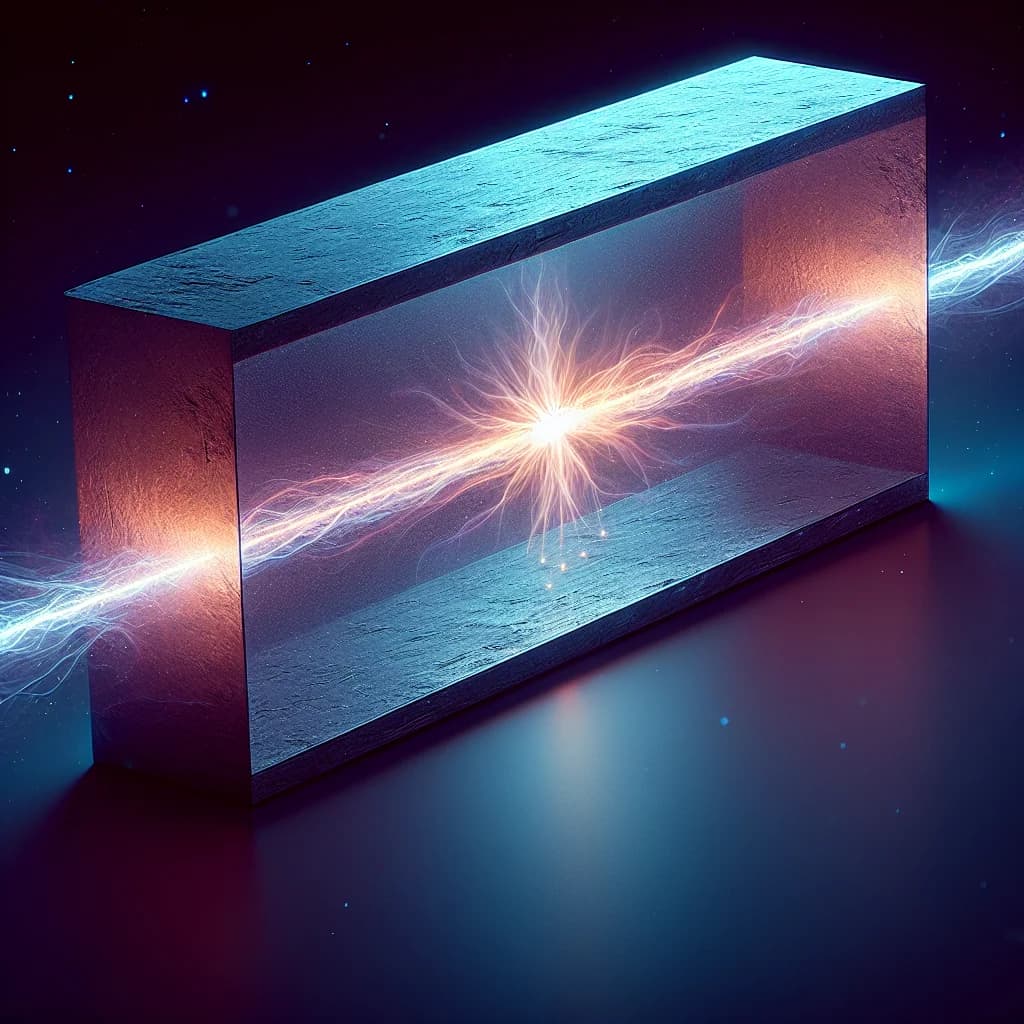
Imagine a block of solid lead stretching from our sun to the nearest stars—a metallic corridor nearly six trillion miles long. To any ordinary object, this would be the ultimate, impenetrable wall. Yet, for a subatomic particle known as the neutrino, this massive barrier is effectively as transparent as clean glass. This "ghost particle" can zip through the entire expanse of lead without slowing down, changing direction, or leaving a scratch.
This thought experiment highlights one of the most baffling realities of quantum mechanics. By examining the principles of particle physics, the nature of the weak nuclear force, and the sheer emptiness of "solid" matter, we can uncover why the universe’s most elusive resident treats a light-year of lead like an open doorway.
The Invisible Voyager: What is a Neutrino?
To understand why neutrinos are so elusive, we first have to look at their "reputation" in the Standard Model of physics. Neutrinos are elementary particles with an incredibly tiny mass—so small it was once thought to be zero. More importantly, they carry no electric charge.
Unlike electrons or protons, neutrinos are essentially "blind" to the electromagnetic force. Because they don't have a charge, they are completely immune to the magnetic fields and electrical attractions that govern how most matter interacts. When a neutrino encounters an atom, it doesn't get pulled in by the nucleus or pushed away by the electron cloud; it simply glides past.
The Weakest Link: The Role of the Weak Nuclear Force
In physics, particles interact through four fundamental forces. Since neutrinos are neutral, they ignore electromagnetism. They are too light for gravity to have much immediate effect on their path, and they don't feel the strong nuclear force that holds atomic nuclei together.
This leaves them with only one way to "touch" the world: the weak nuclear force. As the name suggests, this force has an incredibly short range—about 0.1% the diameter of a proton. For a neutrino to actually hit something, it must pass within this infinitesimally small distance of another particle's "heart."
Doing the Math: The Probability of a Collision
Scientists use a metric called a cross-section to describe the likelihood of particles colliding. Think of the cross-section as the size of the "target" a particle presents.
- The Target Size: For a typical neutrino, the cross-section is roughly $10^{-47}$ square meters. To put that in perspective, if an atom were the size of a football stadium, the neutrino’s target would be smaller than a single grain of sand hidden somewhere inside that stadium.
- The Mean Free Path: By calculating the density of atoms in lead and the tiny cross-section of the neutrino, physicists determine the "mean free path"—the average distance a particle travels before an interaction occurs. For a low-energy neutrino moving through lead, that distance is approximately one light-year (9.46 trillion kilometers).
Essentially, the math tells us that the "thickness" of lead required to guarantee a 50/50 chance of stopping a neutrino is so vast that it exceeds the scale of our entire solar system.
The Illusion of Solidity
The reason we find this scenario so shocking is that we view lead as "solid." However, at the subatomic level, lead—like all matter—is mostly empty space.
- Atomic Architecture: An atom consists of a tiny nucleus surrounded by a distant cloud of electrons.
- The Void: If the nucleus of a lead atom were the size of a marble, the nearest electron would be about half a mile away.
- The Neutral Pass: Most particles are stopped by lead because their electric charges interact with the lead atoms' electrons. Because the neutrino has no charge, it doesn't "see" the electrons at all. It only sees the tiny nuclei, which are spaced so far apart that the neutrino has almost zero chance of a direct hit.
Conclusion
The thought experiment of a neutrino traversing a light-year of lead is a testament to the strange rules of the quantum world. This phenomenon occurs because neutrinos lack an electric charge and rely solely on the short-ranged weak nuclear force for interactions. To a neutrino, "solid" lead isn't a wall; it’s a vast, empty vacuum punctuated by rare, microscopic obstacles it is statistically unlikely to ever strike.
While this may seem like a distant theoretical puzzle, it is a daily reality. Trillions of neutrinos from the sun are streaming through your body at this very moment, passing through the entire Earth and out the other side without leaving a trace. We live in a universe of ghosts, where the most substantial structures we can imagine are, to the smallest particles, nothing more than a gentle mist.