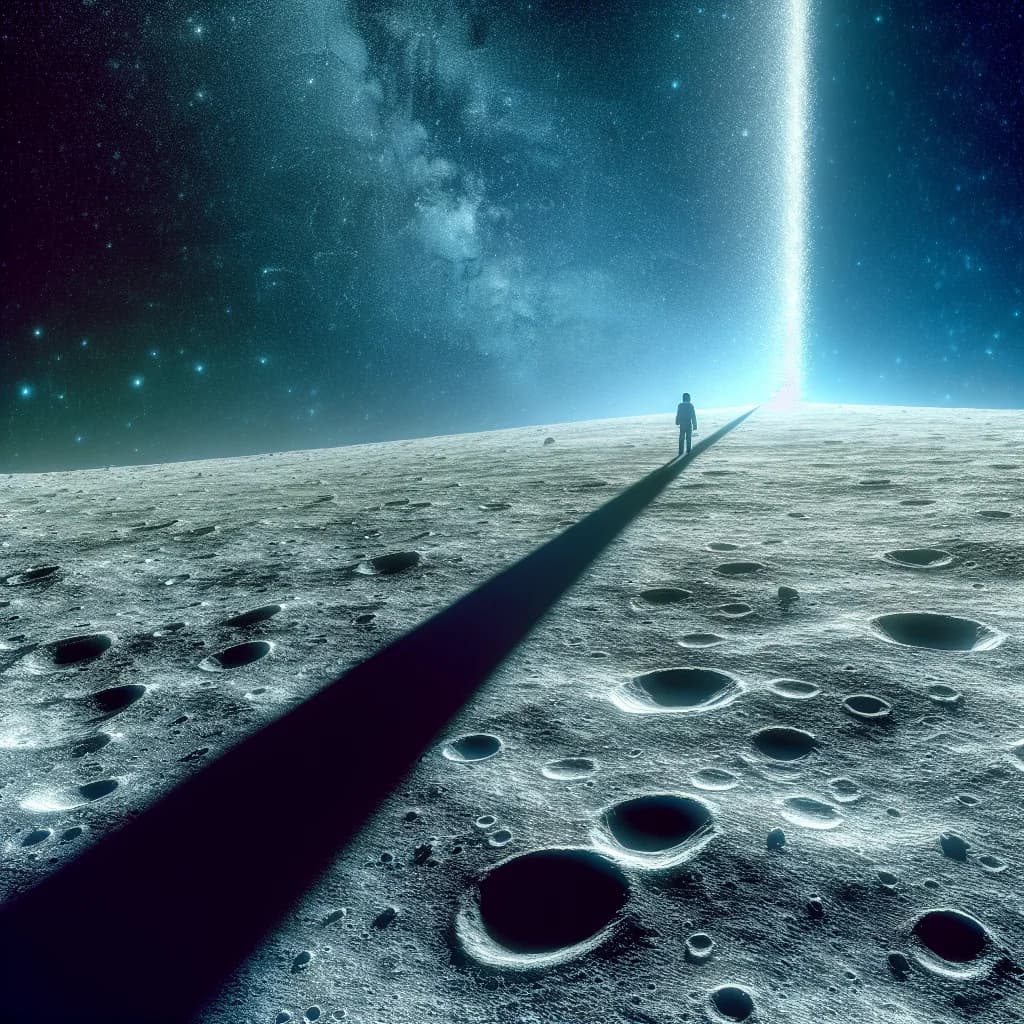
Why would a human be able to run across the surface of a pool of water on the Moon
Forget walking on the lunar surface; imagine sprinting across a pool of water without sinking an inch. Discover the mind-bending physics that would turn any astronaut into a high-speed water-runner in the Moon’s low gravity.

Too Long; Didn't Read
On the Moon, gravity is only one-sixth as strong as on Earth, significantly reducing a person's effective weight. This lower gravitational pull allows humans to generate enough upward force by running and striking the water's surface to stay afloat, a feat physically impossible under Earth's stronger gravity.
Could You Run Across a Pool of Water on the Moon? The Physics of Lunar Hydrodynamics
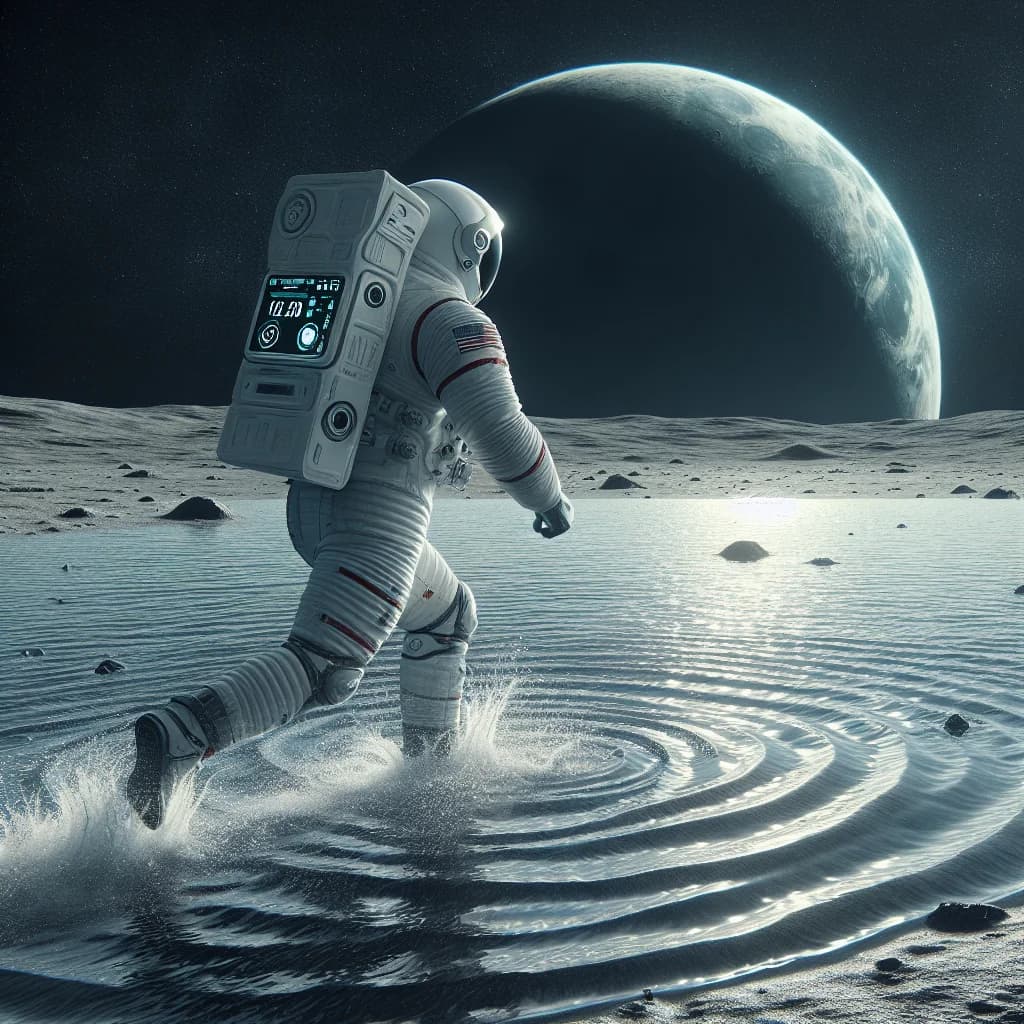
Imagine standing on the edge of a vast, tranquil pool of water nestled inside a lunar crater. In the silent, low-gravity environment of the Moon, you take a deep breath, sprint toward the edge, and leap. On Earth, this would result in a clumsy splash and a quick descent to the bottom. But on the Moon, something miraculous happens: your feet slap the surface, creating tiny geysers of spray, and you find yourself sprinting across the water’s surface like a futuristic superhero.
While this sounds like the climax of a science fiction film, it is actually a grounded scientific hypothesis. By examining the intersection of fluid dynamics, biomechanics, and gravitational physics, we can determine exactly why the Moon’s unique environment turns the "impossible" feat of running on water into a legitimate physical reality.
The Earthbound Obstacle: Why We Sink
To understand why we can run on water on the Moon, we must first understand why we fail on Earth. To stay atop a liquid surface, a human must generate an upward force equal to their body weight. This is achieved through two primary mechanisms:
- Hydrodynamic Slap: The force generated when the foot hits the water surface.
- Hydrostatic Lift: The pressure generated as the foot pushes through the water, creating a temporary "pocket" of air.
On Earth, a human would need to run at roughly 30 meters per second (about 67 miles per hour) to generate enough force to stay afloat. For perspective, Usain Bolt’s top speed is approximately 12 meters per second. Essentially, our Earth-weight is far too high for our leg muscles to produce the necessary "slap" and "lift" to counteract gravity.
The Lunar Advantage: Gravity as a Game-Changer
The Moon’s gravitational pull is only about 1.62 m/s², which is roughly 1/6th (or 16.5%) of Earth’s gravity. This change shifts the entire physical equation in our favor.
The Weight Reduction Factor
If you weigh 180 pounds (about 81 kilograms) on Earth, your lunar weight is a mere 30 pounds. This is the single most important variable in our experiment. Because your "weight" is significantly reduced, the amount of upward force required from the water to support you also drops by 84%.
Kinetic Energy and Foot Frequency
In 2012, researchers led by Alberto Minetti conducted an experiment using a harness to simulate reduced gravity. They found that at 1/6th gravity, the human body no longer requires superhuman speeds to stay above the water.
- The Velocity Threshold: On the Moon, a human only needs to maintain a speed of about 2 to 3 meters per second to stay on the surface.
- The Effort Comparison: This speed is roughly equivalent to a brisk jog or a slow run—well within the capabilities of an average healthy adult.
The Mechanics of the Lunar Sprint
When your foot strikes the water on the Moon, it doesn't just sink. Because the gravity is so low, the "slap" of your foot creates a much more significant upward reaction force relative to your lunar weight.
- Hydrodynamic Support: Each step creates a column of displaced water. On the Moon, the inertia of that water provides enough resistance to push your lightened body back upward before your foot sinks too deep.
- The "Jesus Lizard" Comparison: On Earth, the Basilisk lizard (often called the "Jesus Christ lizard") can run on water because it is small and its feet move incredibly fast. On the Moon, humans effectively become "giant Basilisk lizards" because the environment compensates for our larger mass.
Environmental Consequences: A Different Kind of Splash
If you were to successfully run across a lunar pool (assuming it was housed in a pressurized dome to prevent the water from boiling away in the vacuum), the physical feedback would be surreal.
Because of the low gravity, the splashes you create would rise much higher and fall much slower than on Earth. Instead of a quick spray, you would be followed by a cascading "curtain" of water droplets that linger in the air, creating a slow-motion wake. Furthermore, because there is no atmospheric drag to slow the water down (if we consider a vacuum-adjacent environment), the droplets would follow perfect parabolic arcs, making the experience visually spectacular.
Conclusion
The dream of running across water isn't just a fantasy; it is a matter of adjusting the variables of the universe. By reducing gravity to 1/6th of its Earthly strength, the physics of fluid dynamics shift from being an obstacle to being an ally. The lunar environment lowers the "entry fee" for water-running, allowing the human muscular system to finally overcome the downward pull of weight.
This thought experiment serves as a fascinating reminder that our physical "limits" are often just products of our environment. On another world, the laws of physics remain the same, but they manifest in ways that turn ordinary humans into creatures capable of extraordinary, logic-defying feats.