Why would a planet be covered in burning ice that remains solid at five hundred degrees
On this alien world, the laws of physics are rewritten by ice that stays solid at a blistering 500 degrees while appearing to "burn" in a perpetual flame. Discover the mind-bending secret behind this cosmic paradox that defies everything we thought we knew about the universe.

Too Long; Didn't Read
Intense gravitational pressure on exoplanets like Gliese 436 b compresses water into a dense state called Ice VII, allowing it to remain solid despite scorching temperatures of 500 degrees.
How Can a Planet Be Covered in Burning Ice at 500 Degrees? The Science of Gliese 436 b
Imagine a world where the laws of nature seem to have flipped a switch. In this alien landscape, you step out onto a surface of solid ice, only to find it is radiating heat at a staggering 500 degrees Celsius. It sounds like a paradox pulled straight from a science fiction novel: ice that burns. However, in the vast laboratory of the cosmos, such a place actually exists. This phenomenon isn't magic; it is the result of a cosmic tug-of-war between extreme thermal energy and colossal gravitational force.
To understand how a planet like Gliese 436 b maintains a frozen shell while being cooked by its local star, we must look at the disciplines of thermodynamics and planetary physics. By examining the "phase diagrams" of water and the crushing realities of planetary mass, we can uncover how "hot ice" becomes a physical reality.
The Secret Ingredient: High-Pressure Physics
On Earth, we are used to water following a simple set of rules: it freezes at 0°C and boils at 100°C. But these rules only apply at our standard atmospheric pressure. When you change the pressure, you change the behavior of the molecules.
In the case of a "Hot Neptune" like Gliese 436 b, the planet’s massive gravity creates a high-pressure environment that is billions of times stronger than what we experience on Earth. This pressure is so intense that it forces water molecules into a dense, solid state, regardless of how high the temperature climbs.
The Rise of Ice VII
When water is subjected to pressures exceeding 30,000 times Earth's atmospheric pressure, it transitions into exotic forms of ice, such as Ice VII. Unlike the hexagonal ice in your freezer (Ice Ih), Ice VII has a cubic crystalline structure. It is significantly more dense and remains stable at temperatures that would vaporize any lake on Earth. On a planet like Gliese 436 b, the water is effectively "squeezed" into a solid before the heat has a chance to turn it into steam.
Quantifying the Crushing Weight
To put this into perspective, let’s look at the metrics involved:
- Temperature: The planet orbits its star at a distance of only 2.5 million miles (for comparison, Earth is 93 million miles from the Sun). This results in surface temperatures around 500°C (932°F).
- Pressure: The gravitational pull of the planet's massive core compresses the water layers with a force measured in Gigapascals (GPa).
- Comparison: The pressure required to create these hot ices is roughly equivalent to the weight of an entire mountain range pressing down on a single square inch of surface area.
While the heat is high enough to melt lead, the gravity acts like a microscopic vice, locking the water molecules into a lattice. This creates a planet covered in a thick, solid mantle of "hot ice" that would feel rock-hard to the touch.
Why Does It Look Like It’s "Burning"?
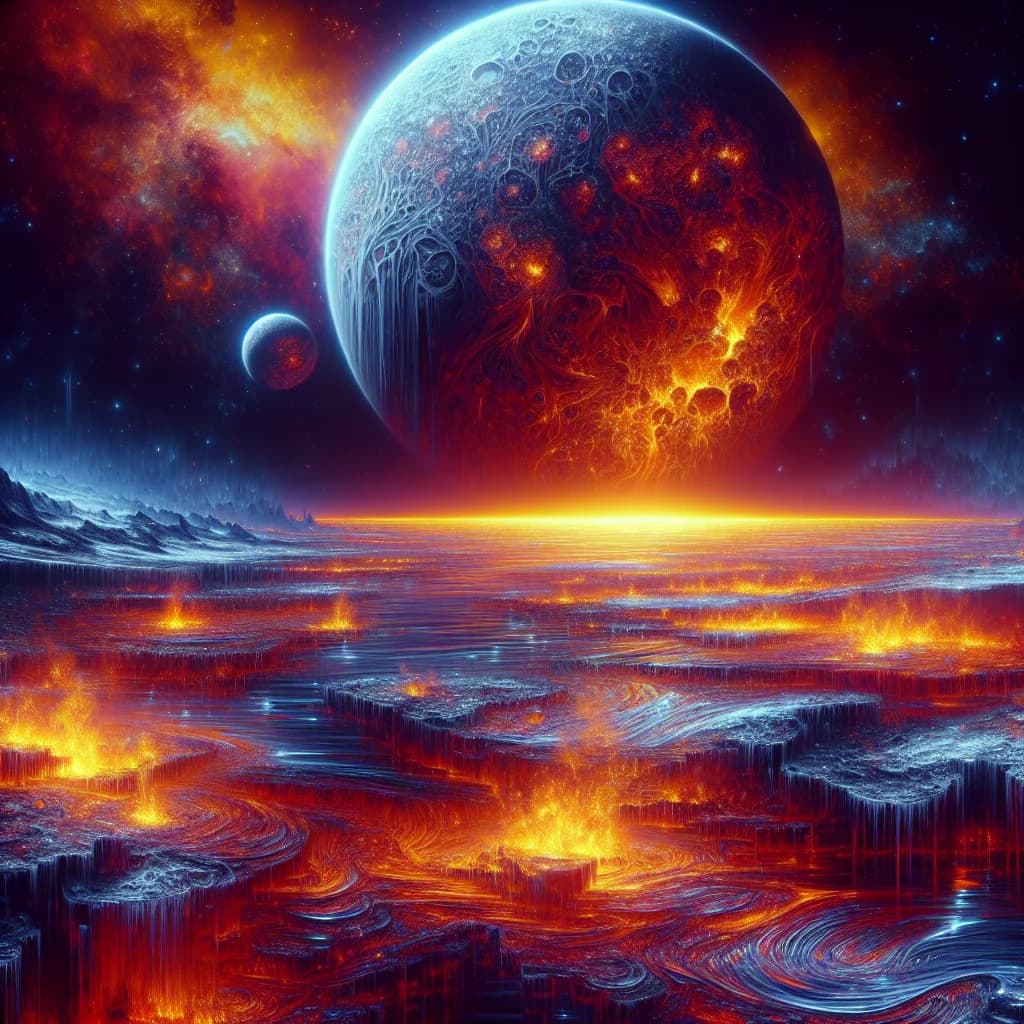
The term "burning ice" is often used because of the planet's intense thermal radiation. At 500°C, the ice would glow with a dull red heat. Furthermore, despite the solid surface, the extreme temperature causes the outer layers of the atmosphere to evaporate, creating a massive cloud of water vapor that trails behind the planet like a comet’s tail.
This leads to a fascinating environmental cycle:
- Compression: Gravity pulls water inward, solidifying it into exotic ice.
- Radiation: The nearby star heats the surface to extreme levels.
- Evaporation: A fraction of the water escapes the gravitational grip, forming a "hydrogen bleed" that stretches millions of miles into space.
Conclusion
The existence of a planet covered in burning ice is a stunning reminder that our terrestrial experiences are only a tiny slice of the universal pie. The "burning ice" of Gliese 436 b is the ultimate victory of gravity over heat. By utilizing the principles of high-pressure thermodynamics, we can see that "solid" and "hot" are not mutually exclusive—given enough pressure, water can be as hard as rock even in a furnace.
This extreme world teaches us that as we peer further into the galaxy, we should expect the unexpected. The universe does not just follow the rules we see on Earth; it plays with the sliders of pressure and temperature to create wonders that challenge our very definition of the elements.