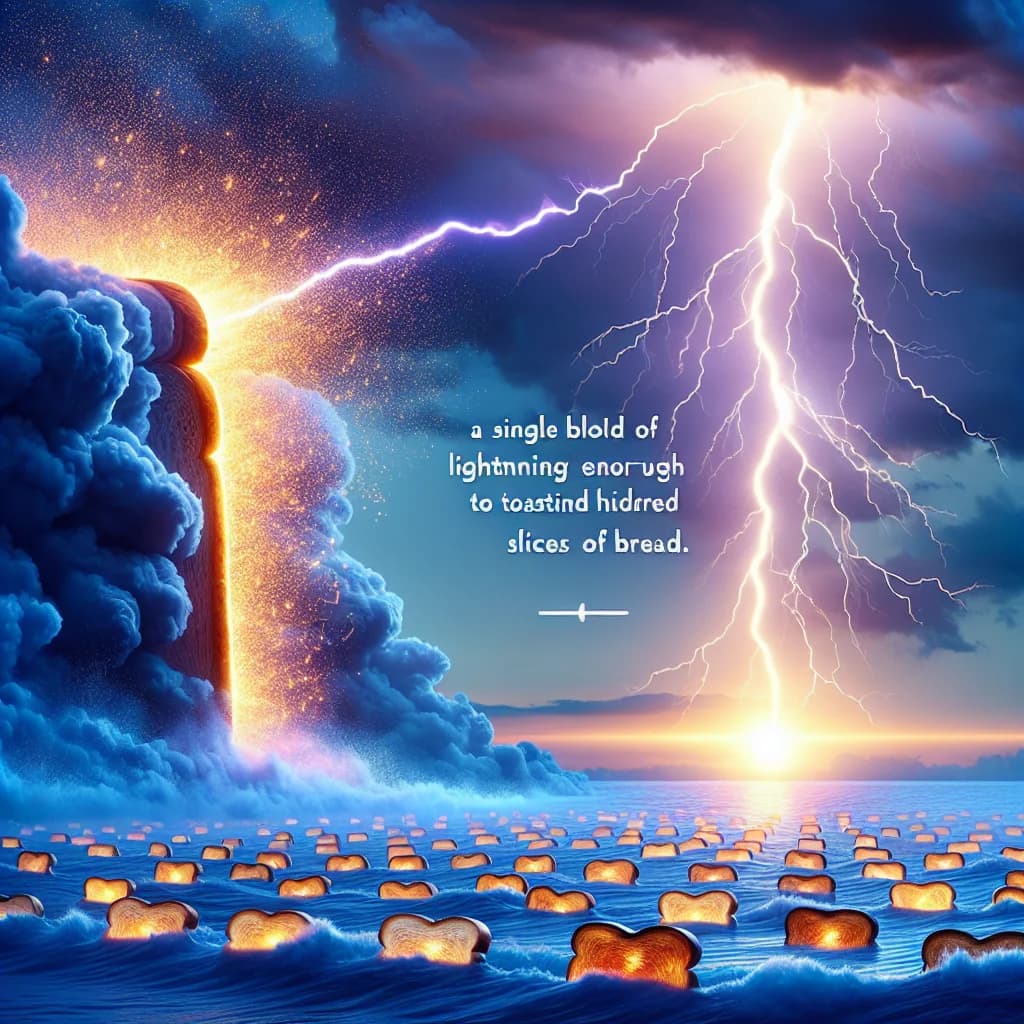
Why would a single bolt of lightning contain enough energy to toast one hundred thousand slices of bread
Imagine a single flash from the sky fueling a breakfast feast for an entire city in just a fraction of a second. Explore the mind-blowing physics of lightning and discover how nature packs enough raw energy into one bolt to toast 100,000 slices of bread.

Too Long; Didn't Read
A single lightning bolt generates up to five billion joules of energy due to extreme voltage and current. Because toasting one slice of bread requires a relatively small amount of electricity, the massive power released in one strike is mathematically sufficient to brown 100,000 slices of bread at once.
The 100,000 Slice Question: The Electrifying Physics Behind Nature’s Most Powerful Breakfast
Imagine a morning where your breakfast prep involves a localized thunderstorm rather than a kitchen appliance. It sounds like the plot of a science-fiction comedy, yet the mathematics behind this absurdity is surprisingly grounded. When we see a flash of lightning, we are witnessing a massive atmospheric discharge that momentarily bridges the gap between the sky and the ground. But could this singular, split-second event really power a kitchen marathon of 100,000 slices of toast?
To answer this, we must dive into the world of electrical physics, thermal dynamics, and energy conversion. This thought experiment relies on calculating the total energy output of a standard lightning bolt—measured in gigajoules—and comparing it to the energy consumption of a standard household toaster. By breaking down the metrics of nature’s electricity, we can determine if the "100,000 slice" claim is a culinary myth or a shocking reality.
The Magnitude of a Bolt: Measuring Gigajoules
Before we can start buttering bread, we have to understand the sheer scale of the energy source. A single bolt of lightning is not just a bright light; it is a massive flow of electrons. On average, a typical lightning strike carries roughly 15,000 to 30,000 amperes of current and delivers about 1 to 5 billion joules of energy.
To put a "billion joules" (one gigajoule) into perspective, consider these comparisons:
- One gigajoule is equivalent to the energy stored in approximately 8 gallons of gasoline.
- It is enough energy to power a 100-watt lightbulb for roughly four months.
- In terms of residential electricity, a single "mighty" bolt contains about 1,400 kilowatt-hours (kWh).
Because the energy is delivered in a fraction of a second—usually about 30 microseconds—the power (energy over time) is astronomical, reaching levels that exceed the output of several nuclear power plants combined for that fleeting moment.
The Toaster’s Requirement: The Math of the Morning Meal
Now, let’s look at the other side of the equation: the humble toaster. A standard two-slice toaster usually operates at about 1,000 watts. If it takes approximately one minute to achieve that perfect golden-brown crunch, we can calculate the energy used:
- Power (1,000 Watts) × Time (60 seconds) = 60,000 Joules.
- Since that energy toasts two slices, a single slice of bread requires roughly 30,000 Joules.
If we take a lightning bolt on the higher end of the spectrum—containing 3 billion joules—and divide it by the 30,000 joules required per slice, the result is exactly 100,000 slices of toast.
The Challenge of Delivery: Why We Don’t Use Storms for Brunch
While the raw energy is there, the physics of "harvesting" it presents a significant obstacle. Lightning is famously difficult to catch, but if we were to try, we would face two primary scientific hurdles:
1. The Resistance Factor
Lightning travels through the air by turning it into plasma, which is incredibly hot—reaching temperatures of 50,000 degrees Fahrenheit (five times hotter than the surface of the sun). If you were to channel this directly into a toaster, the metal filaments would not just heat up; they would instantly vaporize.
2. Time and Transfer
A toaster needs a steady flow of energy over 60 seconds. A lightning bolt delivers all its energy in less than a millisecond. To make this work, we would need a massive "buffer"—likely a giant capacitor bank—to catch the energy all at once and then bleed it out slowly to our bread-toasting stations. Without this, you wouldn't get 100,000 slices of toast; you would get one very loud explosion and a cloud of bread crumbs.
Conclusion: Nature’s Incredible Scale
The hypothetical scenario of toasting 100,000 slices of bread with one lightning bolt is scientifically sound when we look at the raw energy numbers. It serves as a brilliant illustration of just how much power is moving through the atmosphere during a storm. A single discharge is not just a visual spectacle; it is a massive reservoir of energy governed by the laws of electromagnetism and thermodynamics.
Ultimately, this thought experiment reminds us that while we have mastered the art of the perfect breakfast through controlled, steady currents, we are still small in comparison to the atmospheric engines overhead. Nature doesn't just do things on a grand scale; it does them with enough energy to feed an entire stadium breakfast in the blink of an eye.