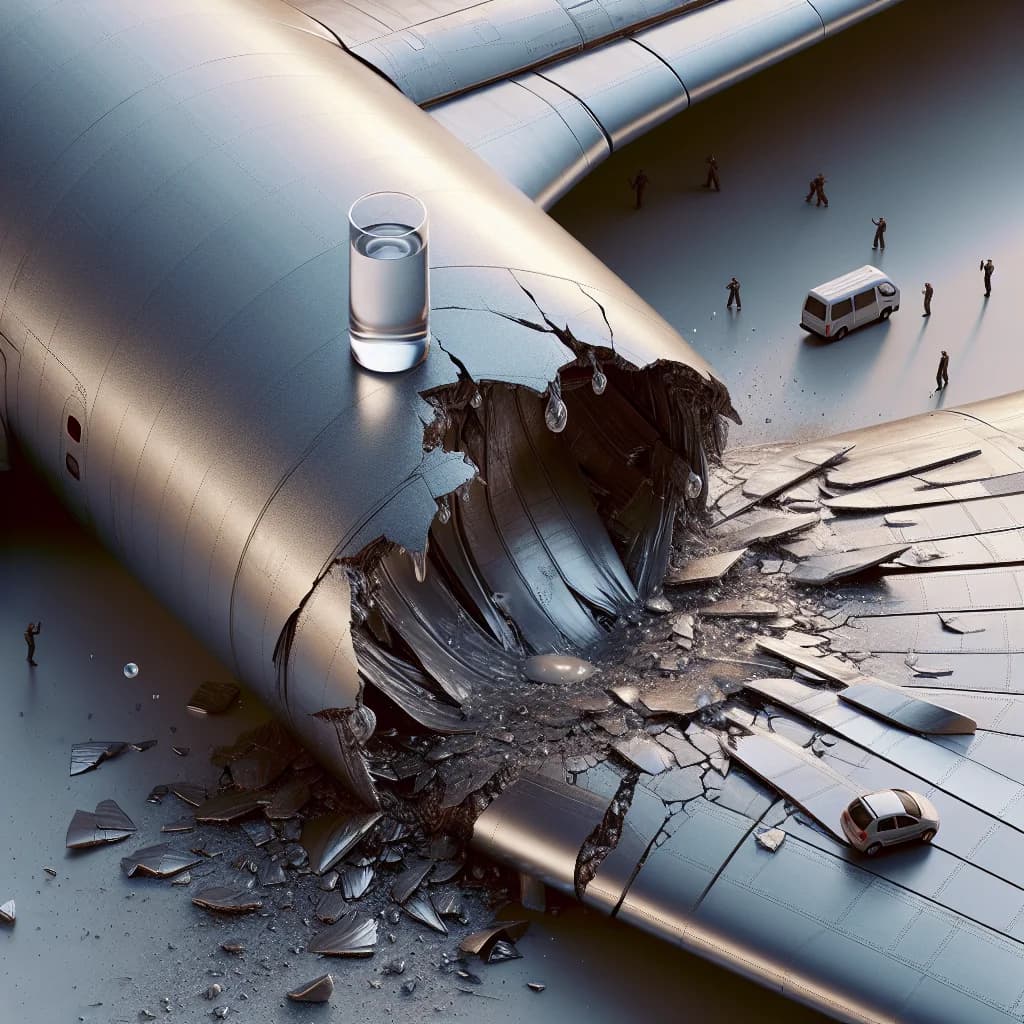
Why would a single drop of liquid gallium cause a massive aluminum airplane wing to crumble like a cracker
It looks like harmless liquid silver, but a single drop can turn a massive aerospace structure into brittle dust in minutes. Discover the terrifying science of liquid metal embrittlement and why this one element is strictly banned from every flight deck on Earth.

Too Long; Didn't Read
Gallium causes liquid metal embrittlement by seeping into the grain boundaries of the aluminum crystal lattice. This process disrupts the molecular bonds holding the metal together, causing the once-strong structure to lose its integrity and shatter with minimal force.
The Chemistry of Catastrophe: Why a Single Drop of Gallium Can Shatter a Massive Airplane Wing?
Imagine a massive commercial airliner, a feat of modern engineering weighing over 150,000 pounds and capable of withstanding extreme turbulence and atmospheric pressure. Now, imagine a single, shimmering droplet of liquid gallium—a metal that melts at roughly the temperature of a warm summer day—resting on its wing. Within hours, that industrial-grade aluminum, designed to be incredibly strong and flexible, begins to lose its integrity, eventually crumbling away with the structural resistance of a salted cracker. This hypothetical scenario highlights a fascinating and terrifying chemical reality. To understand this phenomenon, we must dive into the world of materials science, specifically focusing on a process known as Liquid Metal Embrittlement (LME). This analysis will explore the molecular mechanics of diffusion and the structural vulnerabilities of aluminum alloys.
The Molecular Infiltrator: What is Gallium?
Gallium is a unique element on the periodic table. With a melting point of just 29.76°C (85.57°F), it transitions from a solid to a liquid simply by being held in a human hand. While it appears harmless, it is a "chemical Trojan horse" for aluminum. Aluminum is favored in aerospace engineering because it is lightweight and ductile, meaning it can deform under stress without breaking. However, its strength relies on a specific crystalline structure.
When liquid gallium touches aluminum, it doesn't just sit on the surface; it actively seeks to infiltrate the metal. To do this, it must bypass the aluminum oxide layer—a thin, protective "skin" that naturally forms on aluminum. If that skin is scratched or compromised, the gallium begins its silent invasion.
The Mechanism of Liquid Metal Embrittlement (LME)
The reason an airplane wing "crumbles" rather than melts is due to Liquid Metal Embrittlement. Unlike a typical chemical reaction where two substances create a new compound, LME is more of a physical infiltration at the microscopic level.
1. Grain Boundary Diffusion
Metals are not one solid, continuous block; they are composed of tiny individual crystals called "grains." The areas where these grains meet are called grain boundaries. Under normal conditions, these boundaries are held together by strong metallic bonds, providing the wing with its legendary durability. Gallium, however, has an extraordinary affinity for these boundaries.
- The Infiltration: The gallium atoms wedge themselves between the aluminum grains.
- The Disruption: Once inside, the gallium disrupts the cohesive forces holding the grains together.
- The Result: The metallic bonds are replaced by a thin film of liquid gallium, which has zero shear strength.
2. Loss of Ductility
In a standard aluminum wing, the grains can slide slightly past one another, allowing the metal to bend. When gallium is introduced, the grains are no longer bonded; they are essentially "lubricated" into separation. This transforms the aluminum from a ductile, resilient material into a brittle substance.
Calculations of a Crumbling Giant
To put the scale of this reaction into perspective, consider the following metrics:
- Atomic Scale: A single drop of gallium (approx. 0.1 ml) contains roughly $10^{21}$ atoms.
- Surface Area: In a laboratory setting, a small amount of gallium can compromise an aluminum plate several centimeters thick in just a few hours.
- Mass Ratio: The amount of gallium needed to cause failure is shockingly small. Because it travels along grain boundaries—which account for a tiny fraction of the total volume of the wing—the gallium does not need to "dissolve" the wing. It only needs to "unzip" the connections between the grains.
Comparing this to a real-world metric, it is similar to removing the mortar from between every single brick in a skyscraper. The bricks (the aluminum grains) remain intact, but the structure (the wing) loses all ability to support weight.
Cascading Consequences
Once the gallium begins its journey, the structural integrity of the wing faces a rapid decline:
- Stress Fractures: As the airplane experiences standard aerodynamic lift, the brittle areas cannot flex. Micro-fractures form instantly.
- Propagation: These fractures act as pathways, allowing the liquid gallium to flow even deeper into the wing's internal spars through capillary action.
- Structural Failure: Within a localized area, the aluminum loses up to 90% of its tensile strength. The once-solid metal can literally be snapped off by hand, resembling the texture of a dry biscuit or a cracker.
Conclusion
The transformation of a high-tech airplane wing into a brittle, crumbling mess is a sobering demonstration of Liquid Metal Embrittlement. Through the process of grain boundary diffusion, a tiny amount of liquid gallium can effectively "unplug" the atomic bonds that give aluminum its strength. This chemical interaction proves that even the most massive engineering marvels are subject to the fundamental laws of materials science. While this remains a popular scientific "horror story," it serves as a fascinating reminder of why gallium is strictly regulated in the aviation industry. It shows us that in the world of chemistry, the smallest elements often hold the power to dismantle the largest giants.