Why would a solid steel anvil float like a cork if placed in a pool of liquid mercury
Ever seen a massive steel anvil bob like a cork in a bathtub? Step inside the mind-bending world of density to discover the hidden physics that allow heavy metal to float effortlessly on a pool of liquid mercury.

Too Long; Didn't Read
Steel floats in mercury because mercury is significantly denser than steel. According to the principle of buoyancy, an object will float if it is less dense than the liquid it displaces. Since mercury is nearly twice as dense as steel, the heavy anvil stays on the surface much like wood floats on water.
Heavy Metal Magic: Why Would a Solid Steel Anvil Float Like a Cork in Mercury?
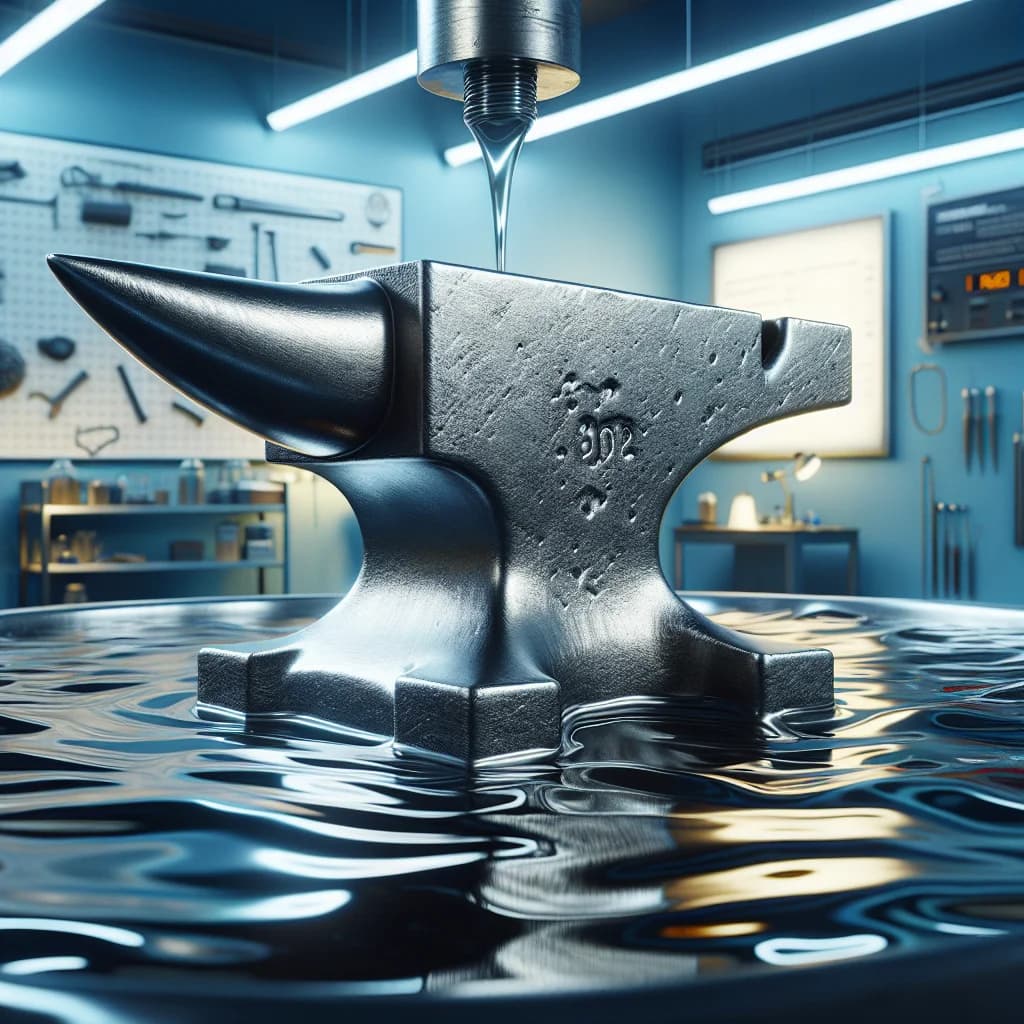
Imagine standing over a vat of shimmering, silver liquid with a massive, 100-pound solid steel anvil in your hands. If you were to drop that anvil into a swimming pool, it would plummet to the bottom instantly, a victim of its own immense weight. But in this experiment, the liquid isn’t water—it is elemental mercury. Instead of sinking, the anvil hits the surface and bobs with the effortless grace of a rubber ducky in a bathtub.
This scenario seems to defy our everyday intuition about weight and "heaviness." We are conditioned to think of steel as the ultimate sinker. However, this fascinating phenomenon is a perfect laboratory for exploring fluid dynamics and the fundamental laws of physics. By applying the principles of density and buoyancy, we can uncover exactly why one of the densest tools in the blacksmith’s shop becomes a floating toy when placed in a pool of liquid metal.
The Density Duel: Steel vs. Mercury
To understand why the anvil floats, we must first look at the "crowdedness" of the atoms within our materials, a property known as density. Density is defined as mass per unit volume (Density = Mass / Volume). For an object to sink in a fluid, it must be more dense than that fluid. If it is less dense, the fluid will push it upward.
Let’s look at the numbers:
- Solid Steel: Most steel alloys have a density of approximately 7,800 kilograms per cubic meter (kg/m³).
- Liquid Mercury: This remarkable metal, which remains liquid at room temperature, has a staggering density of approximately 13,534 kg/m³.
When you compare these two, the result is clear: Mercury is nearly 1.7 times as dense as steel. In the world of physics, this is a massive margin. Even though a steel anvil feels incredibly heavy to a human, it is "light" compared to an equal volume of liquid mercury.
Archimedes’ Principle in Action
The primary scientific law governing this interaction is Archimedes’ Principle. It states that any object, wholly or partially immersed in a fluid, is buoyed up by a force equal to the weight of the fluid displaced by the object.
Think of it as a game of physical displacement:
- As the anvil enters the mercury, it pushes some of the liquid out of the way.
- Because mercury is so incredibly heavy, the weight of the mercury being pushed aside adds up very quickly.
- The upward buoyant force becomes equal to the anvil's downward gravitational force (its weight) long before the anvil is fully submerged.
Because steel is only about 58% as dense as mercury, the anvil only needs to displace a volume of mercury equal to 58% of its own size to achieve equilibrium. This means that roughly 42% of the anvil will remain sticking out above the surface. To put this in perspective, an oak log floating in water often sits lower in the pool than a steel anvil would in mercury!
Visualizing the Scale
To help conceptualize these abstract numbers, consider the following comparisons:
- The Water Equivalent: For a steel anvil to sink in mercury, you would need to find a liquid significantly denser than steel. If we were using water (density of 1,000 kg/m³), the anvil is 7.8 times denser, which is why it sinks like a stone.
- The Cork Comparison: A cork floats in water because it is roughly 25% as dense as the water. While the anvil/mercury ratio isn't quite that extreme, the visual effect is similar. The anvil doesn't just "hover" at the surface; it actively resists being pushed down.
Physical Consequences and Stability
If you were to try and force the anvil under the surface, you would feel a massive amount of resistance, similar to trying to hold a large beach ball under the water in a swimming pool. Furthermore, because the anvil is so stable in this environment, it would be difficult to tip over. The center of buoyancy and the center of gravity would work together to keep the heavy base of the anvil submerged while the "horn" poked proudly into the air.
Conclusion
The sight of a solid steel anvil floating like a cork is a vivid reminder that "heaviness" is relative. While we perceive steel as a heavy material, it is practically buoyant when compared to the extraordinary density of liquid mercury. This outcome is dictated strictly by the ratio of densities and the unwavering mechanics of Archimedes’ Principle.
Ultimately, this thought experiment highlights the hidden wonders of the physical world. It shows us that our common sense is often limited by our daily experiences with water and air. When we venture into the extremes of the periodic table, the laws of physics remain the same, but the results can be nothing short of magical.