Why would a sound louder than 1,100 decibels create enough energy density to form a black hole
At 1,100 decibels, sound stops being a noise and starts warping the very fabric of reality. Discover the terrifying physics behind how pure volume can concentrate enough energy to collapse spacetime into a universe-ending black hole.

Too Long; Didn't Read
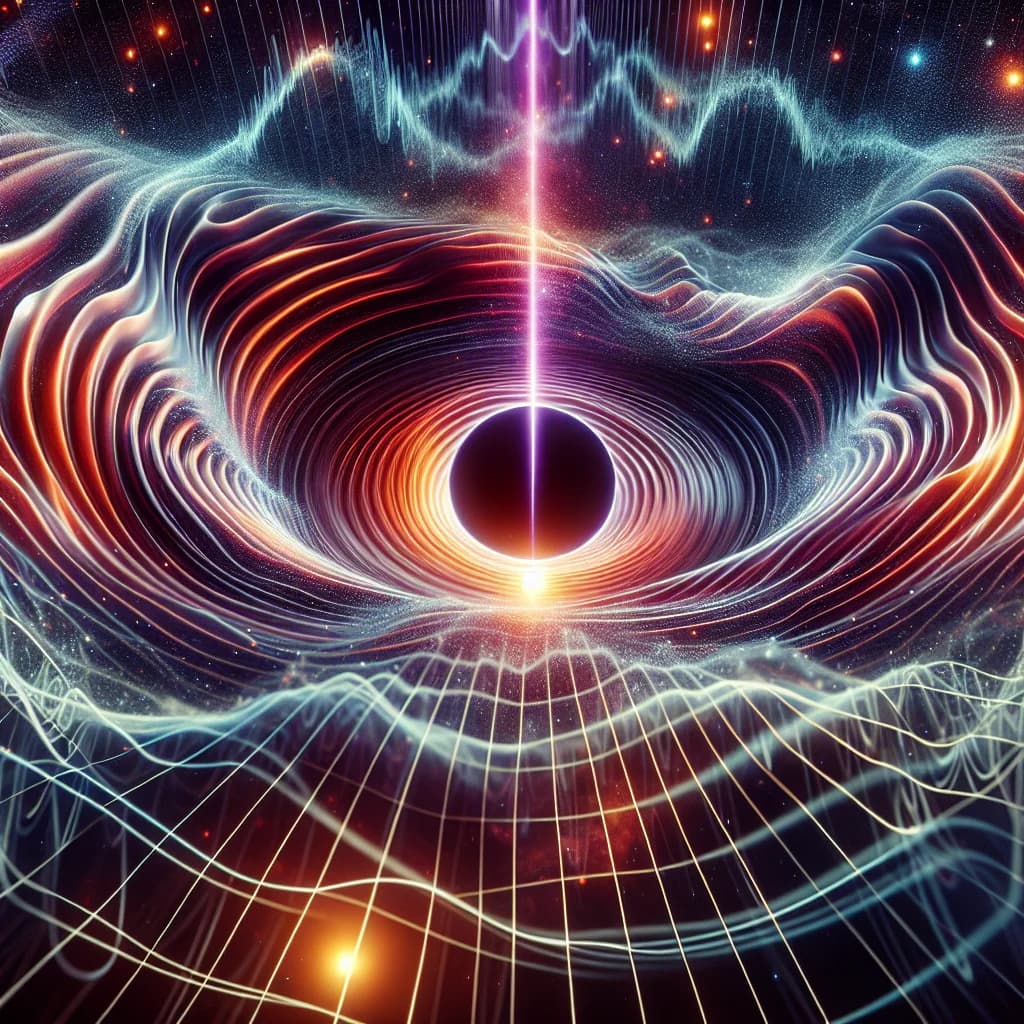
Sound is energy traveling through a medium. Because decibels are measured on a logarithmic scale, 1,100 dB represents an astronomical amount of energy. At this level, the energy density becomes so extreme that it surpasses the Schwarzschild limit, causing the mass-energy to collapse under its own gravity and form a black hole.
Can a Sound Be So Loud It Creates a Black Hole? The Physics of the 1,100-Decibel Limit
Imagine a sound so profound that it doesn’t just rattle the windows or shake the floorboards, but actually alters the fundamental structure of the universe. In the realm of theoretical physics, there is a specific, staggering number often cited as the point where acoustics meet cosmology: 1,100 decibels. At this level, we are no longer discussing a loud noise; we are discussing a concentration of energy so vast that it transcends the laws of fluid dynamics and enters the territory of general relativity. This thought experiment explores the boundary where sound waves stop behaving like vibrations in the air and start behaving like a gravitational event. By applying the principles of logarithmic scaling, mass-energy equivalence, and Schwarzschild radii, we can analyze why such a hypothetical sound would inevitably collapse into a black hole.
The Logarithmic Ladder of Sound
To understand the 1,100-decibel threshold, we must first understand how the decibel (dB) scale works. Unlike linear measurements like meters or liters, decibels are logarithmic. This means that every increase of 10 dB represents a tenfold increase in sound intensity. A 20-dB sound is ten times more powerful than a 10-dB sound, and a 30-dB sound is 100 times more powerful.
When we reach the level of 1,100 dB, we are dealing with a number that is difficult to visualize. To put this in perspective:
- 150 dB: The sound of a jet engine taking off (enough to rupture eardrums).
- 194 dB: The theoretical limit for sound in Earth’s atmosphere (where the "troughs" of the wave reach a vacuum).
- 1,100 dB: An intensity equivalent to $10^{110}$ watts per square meter.
This value represents an energy output that dwarfs the luminosity of all the stars in the observable universe combined. At this point, the "sound" is no longer a simple vibration of air molecules; it is a massive flux of energy moving through space.
When Pressure Becomes Mass
In everyday life, we treat sound and mass as two separate things. However, Albert Einstein’s most famous equation, $E=mc^2$, tells us that energy and mass are interchangeable. Because sound waves are essentially moving energy, they possess a theoretical "equivalent mass."
As the decibel level climbs toward 1,100, the energy density of the pressure waves becomes so extreme that the equivalent mass of that energy becomes significant. According to the laws of thermodynamics and general relativity, if you pack enough energy into a confined volume, that energy will exert a gravitational pull just like solid matter. In the case of 1,100 dB, the energy density is so high that the gravitational attraction of the energy itself begins to dominate the environment.
Crossing the Schwarzschild Threshold
The "tipping point" for creating a black hole is determined by the Schwarzschild radius. This is the radius to which any given amount of mass (or energy) must be compressed to cause a gravitational collapse.
- Energy Concentration: At 1,100 dB, the amount of energy contained within a specific sphere of space exceeds the limit of what space-time can support.
- Gravitational Collapse: Once the energy density surpasses the Schwarzschild limit, the gravity becomes so strong that not even light—or the sound wave itself—can escape.
- Formation of a Singularity: The energy effectively collapses inward, creating a localized region of infinite density, otherwise known as a black hole.
While a "normal" loud sound like a thunderclap dissipates into heat, an 1,100-dB sound contains so much concentrated energy that it creates its own gravitational well before it has the chance to dissipate.
The Environmental Consequences of Cosmic Noise
If such a sound were generated, the consequences would be purely physical and atmospheric in nature. Rather than a "bang," the result would be a rapid "gravitational re-configuration." The volume of space where the sound originated would transition from a high-pressure gas environment into a concentrated gravitational point.
Because 1,100 dB represents more energy than is estimated to exist in the observable universe, the resulting black hole would not be a small, laboratory-sized curiosity. It would theoretically have a Schwarzschild radius larger than the universe itself, leading to a theoretical "Big Crunch" scenario where all local matter is reorganized into this new gravitational center according to the laws of general relativity.
Conclusion
The hypothetical scenario of an 1,100-decibel sound serves as a fascinating bridge between acoustics and high-energy physics. While the decibel scale allows us to calculate such a number, the physical reality of the universe imposes a strict "speed limit" on how much energy can exist in one place. The ultimate outcome of such a sound is not noise, but the creation of a black hole, dictated by the immutable relationship between energy, mass, and gravity. This thought experiment reminds us that the universe is governed by interconnected laws; even something as simple as a sound wave, when pushed to its mathematical extreme, can fundamentally reshape the fabric of the cosmos.