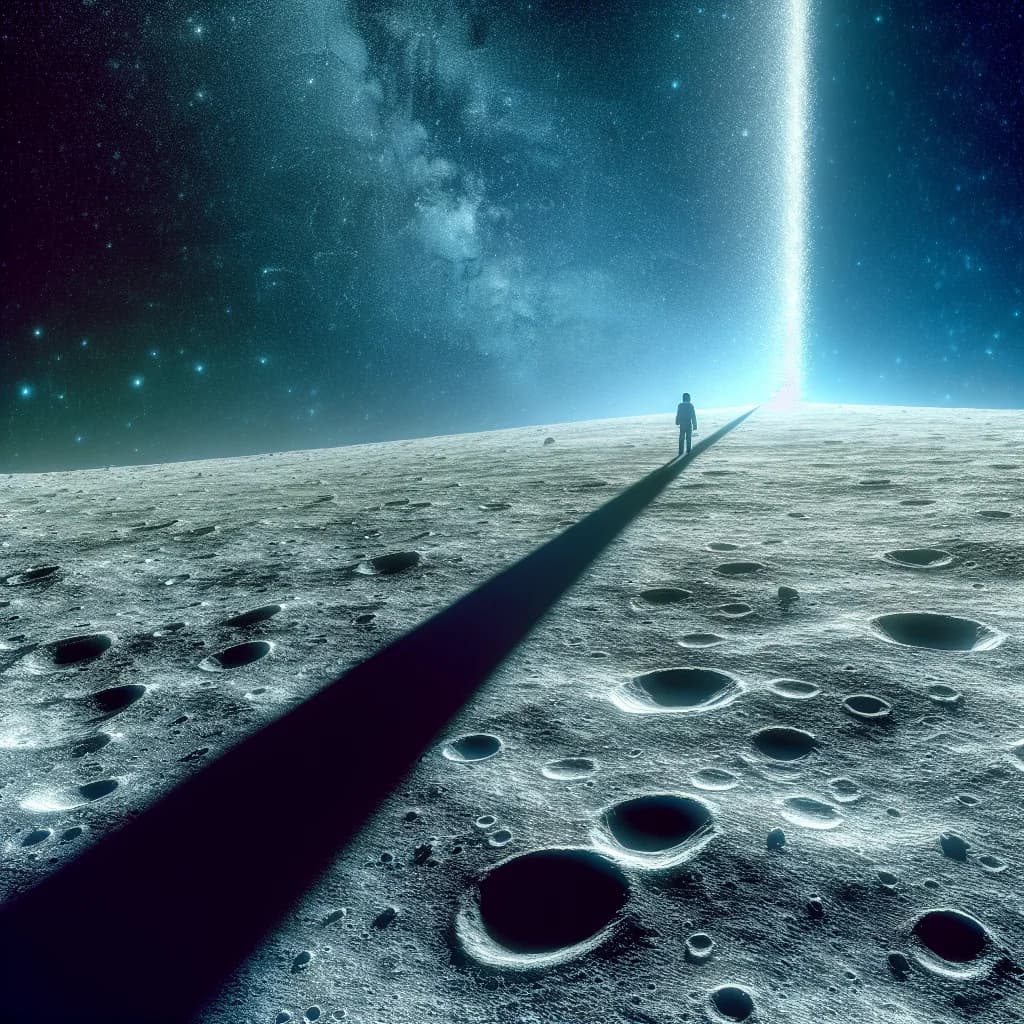
Why would a supermassive black hole be less dense than the air you are currently breathing
It sounds like a cosmic impossibility, but the universe’s most massive giants are technically "fluffier" than the oxygen you’re inhaling right now. Discover the mind-bending physics that makes a billion-sun black hole less dense than a simple breath of air.


Too Long; Didn't Read
As a black hole increases in mass, its radius grows proportionally but its volume expands cubically. Because volume increases so much faster than mass, the average density within the event horizon of a supermassive black hole decreases significantly, eventually becoming lower than the density of Earth's atmosphere.
The Cosmic Paradox: Why a Supermassive Black Hole Could Be Less Dense Than the Air You Breathe
When we think of black holes, we typically imagine objects of infinite "thickness"—the ultimate cosmic heavyweights where matter is crushed into an impossibly small point. However, a fascinating quirk of physics suggests that if you make a black hole large enough, its average density actually drops below that of the very air you are breathing right now. This sounds like a riddle, but it is a direct consequence of Albert Einstein’s General Relativity and the unique way spherical volume scales in our three-dimensional universe. By examining the relationship between mass, radius, and volume, we can uncover how these celestial titans become "fluffy" giants on a mathematical scale.
The Geometry of a Giant: Mass vs. Volume
To understand this paradox, we must first distinguish between the singularity and the event horizon. The singularity is the point of infinite density at the center, but when astronomers talk about the "size" or "density" of a black hole, they are referring to the region enclosed by the event horizon—the boundary of no return.
The radius of this boundary is known as the Schwarzschild radius ($R_s$). According to the laws of physics, the radius of a black hole is directly proportional to its mass ($M$). If you double the mass, you double the radius. However, a black hole is a three-dimensional sphere, and the volume ($V$) of a sphere is calculated as $V = 4/3 \pi R^3$.
This creates a scaling mismatch that leads to our density dilemma:
- Mass increases linearly ($M$).
- Radius increases linearly ($R$).
- Volume increases by the cube ($R^3$).
The Inverse-Square Trap
Because density is defined as mass divided by volume ($\rho = M/V$), and volume grows much faster than mass as the black hole gets bigger, the average density of a black hole actually decreases as it gains weight. Specifically, the density of a black hole is inversely proportional to the square of its mass. The bigger they are, the "thinner" they get.
Crunching the Cosmic Numbers
Let’s look at the math using real-world metrics. The density of dry air at sea level is approximately 1.2 kilograms per cubic meter (kg/m³).
To reach a point where a black hole's average density is lower than air, we need to look at the true heavyweights of the universe: Supermassive Black Holes (SMBHs).
- A Stellar-Mass Black Hole: A black hole with the mass of our Sun would have a radius of only 3 kilometers and a density of about $10^{18}$ kg/m³—far denser than an atomic nucleus.
- The Tipping Point: As we move into the "supermassive" category, the numbers shift. A black hole with a mass of about 3.8 billion Suns would have an average density roughly equal to that of liquid water (1,000 kg/m³).
- The "Air" Threshold: Once a black hole reaches approximately 10 to 40 billion solar masses, its average density drops below 1.2 kg/m³.
The black hole at the center of the galaxy M87 (the first one ever photographed) has a mass of about 6.5 billion Suns. It is already approaching the density of water. Larger examples, like TON 618—which weighs in at an estimated 66 billion solar masses—are significantly less dense than the air in your room.
Crossing the Threshold: The Spaghettification Scale
This low density has a surprising physical consequence for any hypothetical traveler. In smaller black holes, the "tidal forces" (the difference in gravity between your head and your feet) are so violent that they would stretch an object into a thin ribbon—a process scientists clinically refer to as spaghettification.
However, because supermassive black holes are so large and their "average" density is so low, the gravitational gradient at the event horizon is remarkably gentle.
- Weak Tidal Forces: In a 10-billion-solar-mass black hole, the event horizon is billions of kilometers away from the singularity.
- A Quiet Crossing: A traveler could theoretically cross the event horizon of such a "low-density" giant without feeling any physical discomfort at all. You wouldn't be crushed or stretched; you would simply drift into the dark, unaware that you had passed the point of no return.
Conclusion
The idea that a supermassive black hole is "less dense than air" is a powerful reminder that the universe often defies our intuition. While the singularity at the core remains a point of infinite density, the vast neighborhood it commands—the event horizon—is so enormous that its average occupancy of matter is surprisingly sparse. This phenomenon is dictated by the simple geometric reality that volume expands much faster than a radius does. It connects the terrifying power of gravity to the elegant simplicity of spherical mathematics, proving that in the deep cosmos, the most massive objects can also be, in a sense, the most ethereal.