Why would a Tyrannosaurus rex be physically unable to outrun a human without its own leg bones shattering
Hollywood’s favorite predator has a fatal physics problem: if a T. rex ever tried to sprint, its own massive weight would literally cause its leg bones to buckle and snap. Discover the startling biomechanical truth behind why you could actually outrun the "King of Dinosaurs."

Too Long; Didn't Read
Biomechanical simulations show that a Tyrannosaurus rex’s immense body mass created unsustainable stress on its skeleton during high-speed movement. If it attempted to run faster than roughly 12 mph, the impact loads would exceed the structural strength of its leg bones, causing them to fracture or shatter under the pressure.
The Speed Trap: Why a Running T. rex Would Risk Shattering Its Own Legs
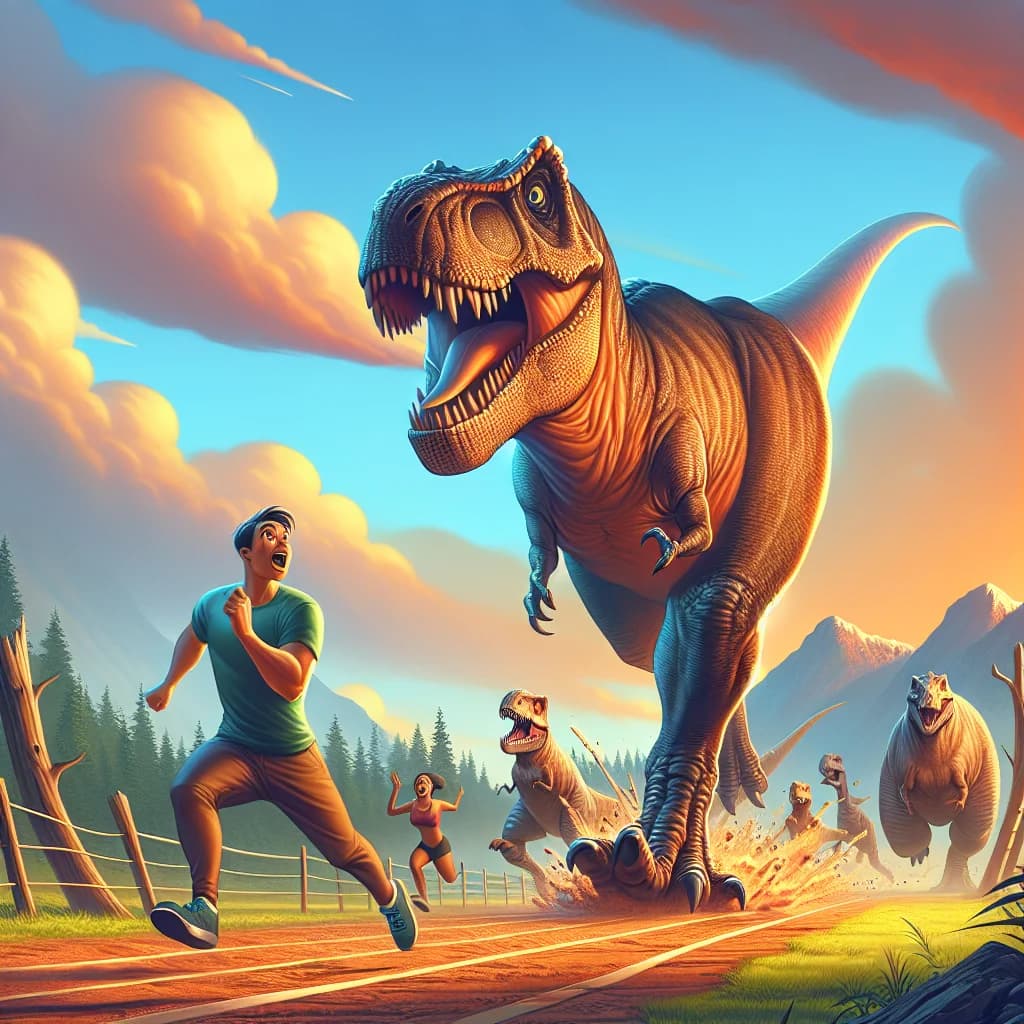
Imagine the classic cinematic image of a Tyrannosaurus rex chasing a Jeep at forty miles per hour, its footsteps shaking the earth with every stride. It is a thrilling thought, but according to modern biomechanics, it is physically impossible. If a seven-ton T. rex attempted to sprint like an Olympic athlete, the laws of physics suggest a catastrophic outcome for the dinosaur’s skeleton. Specifically, the stresses placed upon its leg bones would likely exceed their structural limits, leading to mechanical failure. By applying the principles of the Square-Cube Law and multi-body dynamic simulations, we can analyze the fascinating physical boundaries that kept the "King of the Dinosaurs" from ever winning a gold medal in the 100-meter dash.
The Heavy Weight of the Square-Cube Law
To understand why a T. rex couldn't sprint, we must first look at the Square-Cube Law. This mathematical principle states that as an object grows in size, its surface area increases by the square, but its volume (and thus its mass) increases by the cube.
- Massive Gains: If you double the height of a dinosaur, it becomes four times as strong (based on bone cross-section), but it becomes eight times as heavy.
- The Weight Penalty: A T. rex weighed between 7,000 and 9,000 kilograms (roughly 15,000 to 20,000 pounds). While its femur was massive, the sheer volume of its body grew much faster than the strength of the bone tissue supporting it.
Because of this ratio, large animals have much lower "strength-to-weight" reserves than smaller animals. While a human can jump and land with several times their body weight in force, a T. rex was already living near the structural "red line" of its skeletal capacity just by standing still.
The Biomechanics of the "Flight Phase"
In physics, "running" is defined by a "flight phase" where both feet briefly leave the ground. For a creature of the T. rex's magnitude, this phase is where the danger lies. When the dinosaur lands after a stride, the force of gravity accelerates its massive bulk downward.
The Impact Calculation
When a 8,000 kg organism lands, the impact force is calculated as Force = Mass × Acceleration.
- Mass: 8,000 kg.
- Gravity: 9.8 m/s².
- Impact Multiplier: During a run, the impact can be 2 to 3 times the animal's static weight.
This means the leg bones would need to withstand upwards of 24,000 kilograms of force in a single moment. Computer simulations conducted by paleontologists at the University of Manchester have shown that at speeds exceeding 12 mph (20 kph), the loads placed on the mid-foot and tibia would surpass the breaking point of the bone material. Instead of a graceful sprint, the bone would experience a clinical structural compromise, effectively "buckling" under the impossible load.
Power Walking vs. True Running
Since a true sprint was out of the question, how did the T. rex move? Researchers suggest the dinosaur utilized a "power walk."
- Constant Contact: By always keeping at least one foot on the ground, the T. rex avoided the high-impact "flight phase."
- Energy Efficiency: This gait allowed the animal to maintain a respectable pace of about 10 to 12 miles per hour.
- The Human Comparison: While 12 mph sounds slow, the average human jogs at about 5 to 8 mph. A T. rex could still comfortably outpace a casual hiker without ever breaking into a dangerous run.
Cascading Consequences of High-Speed Movement
If a T. rex were somehow forced to exceed these biological limits, the physical consequences would be immediate and systemic. Beyond the skeletal risks, the muscular energy required to move such mass at high speeds would generate immense thermal energy. Large animals struggle to dissipate heat; a sprinting T. rex would likely experience a rapid rise in internal body temperature, leading to physical exhaustion long before its bones reached their breaking point. The dinosaur was essentially a heavy-duty truck: built for torque and power, not for high-speed racing.
Conclusion
The image of a sprinting T. rex is a marvel of movie magic, but the reality is dictated by the rigid laws of physics and biology. The Square-Cube Law and the mechanical limits of bone tissue ensured that this prehistoric giant remained a "power walker" rather than a sprinter. Its massive frame provided incredible strength and predatory dominance, but it came at the cost of high-speed mobility.
Ultimately, the T. rex reminds us that nature is a master of trade-offs. Even the most formidable predator to ever walk the earth had to respect the fundamental constants of gravity and structural engineering. It didn't need to run like a cheetah to be the king of its domain; it simply needed to be the most efficient walker in the Cretaceous forest.