Why would all the water on a cube-shaped Earth pool into six giant circular lakes at the face centers
If our world were a cube, gravity would treat its flat faces like massive bowls, dragging every drop of water into six colossal, isolated seas. Discover the mind-bending physics that would turn the planet’s corners into airless peaks while the oceans huddle in perfect, giant circles at the center of each face.

Too Long; Didn't Read
Gravity pulls toward the center of mass, making the centers of the six cube faces the lowest points of elevation. Because the corners and edges are significantly further from the core, they act as massive mountain ridges, forcing all water to drain into six distinct circular basins at the midpoint of each side.
Six Seas and Sharp Corners: Why Would Water Pool at the Center of a Cube-Shaped Earth?
Imagine glancing out a spacecraft window and seeing not a swirling blue marble, but a gargantuan, six-sided die floating in the void. This thought experiment—transforming our spherical home into a perfect cube—is a favorite among physicists and geologists alike. While the "Square Earth" theory is a staple of science fiction, it provides a fascinating laboratory for applying the laws of thermodynamics and universal gravitation. If we were to suddenly snap our fingers and reshape the Earth into a cube while maintaining its current mass and water volume, the result would not be six flat oceans. Instead, physics dictates that the water would gather into six distinct, circular reservoirs centered on each face. To understand why, we must look at the relentless pull of gravity and the concept of equipotential surfaces.
The Gravity of the Situation
The fundamental reason water would pool at the center of each face lies in how gravity functions. On a spherical Earth, the surface is roughly equidistant from the center of mass, meaning gravity pulls down with nearly equal strength everywhere. However, a cube is mathematically "pointy."
The center of each face of a cube is much closer to the planet's center of mass than the corners are. Specifically, for a cube with the same volume as Earth, the distance from the center to a corner is approximately 73% greater than the distance from the center to the midpoint of a face. In the world of physics, gravity acts as a radial force; it wants to pull everything toward the center of mass. Consequently, on a cube-shaped Earth, the "downward" pull is strongest at the face centers and weakest at the corners.
The Great Uphill Climb
Because the corners are so much further from the center of mass, they effectively function as massive mountain ranges. If you were standing at the center of one of the cube's faces and tried to walk toward an edge or a corner, you would feel as though you were climbing a progressively steeper incline.
- The Incline: Near the center of a face, the ground feels flat.
- The Slope: As you move outward, the "down" direction (toward the center of mass) begins to point at an angle relative to the ground.
- The Peak: By the time you reached a corner, the slope would be so extreme that it would feel like standing on the peak of a mountain roughly several thousand kilometers high.
Water, being a fluid, always seeks the point of lowest gravitational potential. It "runs downhill" until it can get as close to the center of mass as possible. On a cube, those "low" points are the six centers of the faces.
The Formation of the Six Circular Lakes
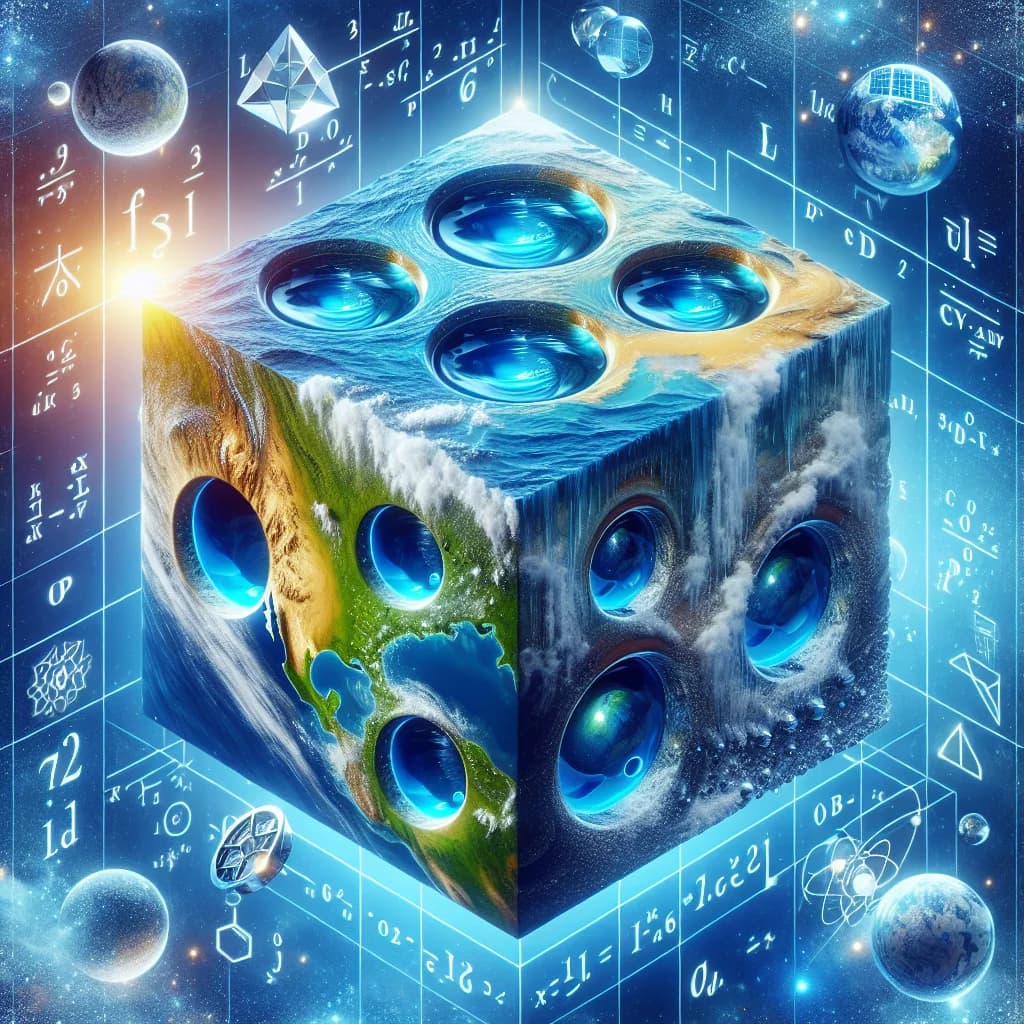
If we distributed Earth’s 1.335 billion cubic kilometers of water onto this cube, the water would naturally flow away from the edges and corners, settling into six isolated "lenses" or spherical caps.
Why are the lakes circular?
Gravity radiates outward from the center of mass in all directions equally. Because the "pull" is symmetrical around the center point of each face, the water level will equalize at a specific distance from that center. This creates a perfectly circular shoreline. Each of these six oceans would essentially be a "bulge" of water, deepest at the very center of the face and thinning out toward the edges.
Estimating the Scale
If we divide Earth’s total water volume by six, each face would host approximately 222 million cubic kilometers of water. While this sounds like a staggering amount, the sheer surface area of a cube-Earth (which would be roughly 25% larger than our current sphere) means these lakes would not cover the entire face.
- The Centers: Deep, navigable oceans with high atmospheric pressure.
- The Edges: Barren, rocky plateaus where the crust is exposed to the vacuum or near-vacuum of space.
Cascading Environmental Effects
The pooling of water wouldn't be the only dramatic change; the atmosphere would follow the same gravitational rules. Just as the water pools at the centers, the air would become densest at the center of each face.
- Atmospheric Concentrates: Each lake would be surrounded by a lush, thick atmosphere.
- The "Thin" Zones: As you moved toward the edges, the air would become rapidly thinner, similar to the "death zone" on Mount Everest, eventually disappearing entirely at the corners.
- Climate Isolation: Each of the six faces would become a self-contained biological island. Traveling from one face to another would require a pressurized spacesuit to cross the airless, waterless ridges of the cube’s edges.
Conclusion
The transformation of Earth into a cube reveals the hidden geometry of gravity. While we perceive our world as a solid, unchangeable shape, it is actually a delicate balance of forces seeking equilibrium. On a cube-shaped planet, the centers of the faces become the only hospitable basins, while the corners tower as impossible peaks reaching into the void. This thought experiment reminds us that the "roundness" of our Earth isn't an accident; it is the natural shape of a world where gravity has won the battle against geometry. Our vast, interconnected oceans are only possible because our planet provides a surface that is—for the most part—equally close to its heart.