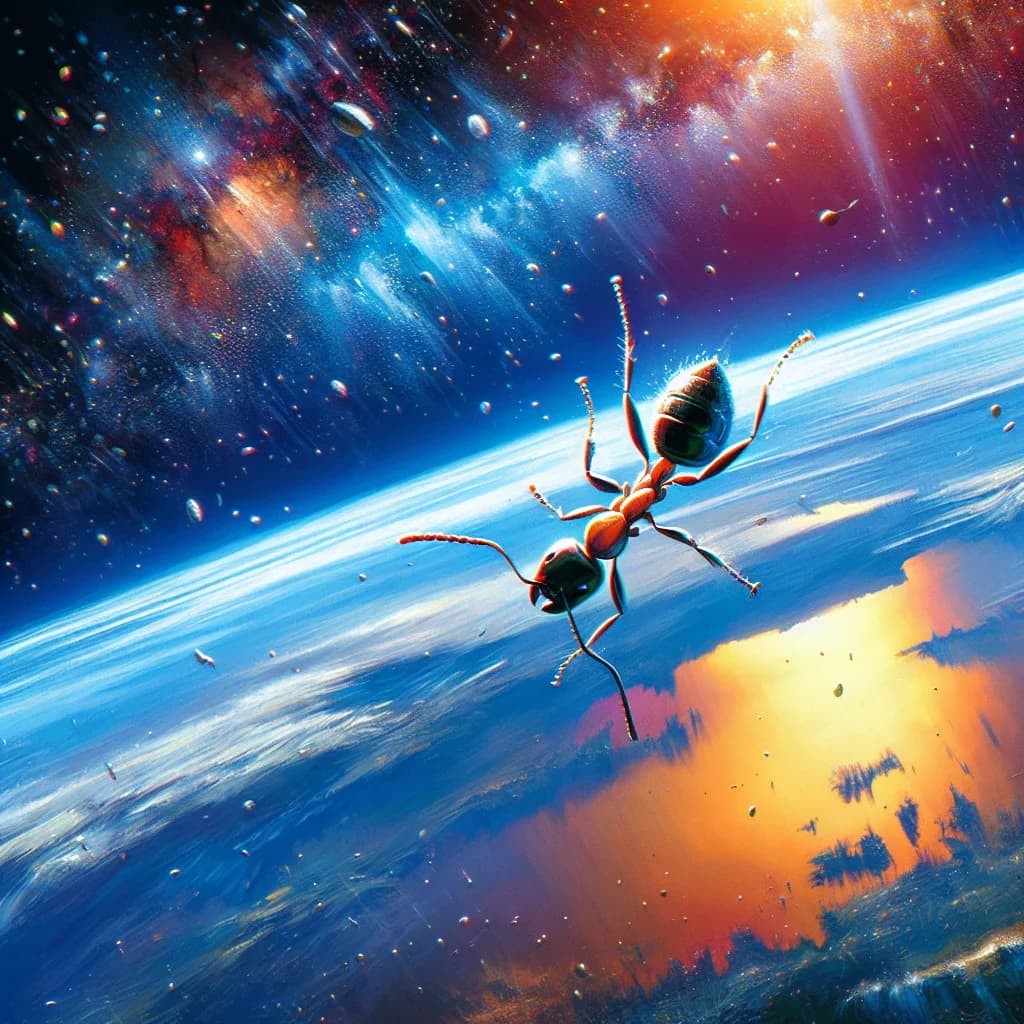
Why would an ant survive a fall from the edge of space without a parachute
Imagine plummeting from the edge of space and simply walking away unharmed upon impact. Discover the mind-bending physics that turn a lethal freefall into a harmless drift for nature’s most resilient tiny travelers.

Too Long; Didn't Read
An ant survives a fall from space because its tiny mass and high air resistance result in an extremely low terminal velocity. By the time it hits the ground, it is only traveling a few miles per hour, a speed its durable exoskeleton can easily withstand.
The Ultimate Space Diver: Why Could an Ant Survive a Fall from the Edge of Space?
Imagine standing at the Karman Line—the invisible boundary 100 kilometers above the Earth where the atmosphere ends and space begins. Now, imagine a tiny common garden ant stepping off that edge. To a human, this would be a catastrophic descent, but for our six-legged protagonist, it is just a very long, very breezy afternoon.
This thought experiment isn’t just a whimsical "what if"; it is a fascinating dive into the fundamental laws of our universe. By examining the intersection of fluid dynamics, the Square-Cube Law, and biological resilience, we can uncover the scientific reasons why an ant is effectively "immune" to falling. While the height is dizzying, the physics governing the ant’s journey ensure that its return to Earth is surprisingly gentle.
The Secret Weapon: Terminal Velocity
The primary reason an ant survives such a massive drop is a concept called terminal velocity. When an object falls, gravity pulls it down, while air resistance (drag) pushes back up. Eventually, these two forces balance out, and the object stops accelerating, falling at a constant speed.
For a human, terminal velocity is roughly 200 kilometers per hour (120 mph). Impacting the ground at that speed results in a massive transfer of kinetic energy. However, an ant is a different story.
The Physics of Drag
The formula for terminal velocity involves mass, gravity, and surface area. Because an ant has an incredibly small mass (roughly 1 to 5 milligrams) but a relatively large surface area for its weight, it reaches terminal velocity almost instantly.
- Human Terminal Velocity: ~55 meters per second.
- Ant Terminal Velocity: ~1.8 meters per second (about 6.4 km/h).
Landing at 6.4 kilometers per hour is equivalent to a human walking into a wall. It is a minor physical event rather than a terminal impact. The ant effectively "parachutes" using its own body.
The Square-Cube Law: Small is Strong
Why does the ant have such a favorable ratio of surface area to mass? This is due to the Square-Cube Law. This mathematical principle states that as an object grows in size, its volume (and thus its mass) grows at a much faster rate than its surface area.
If you were to scale an ant up to the size of a human, its weight would increase by the cube of the scaling factor, but its surface area would only increase by the square. Because the real-world ant is so minuscule, its surface area dominates its physical interactions with the air. It experiences a massive amount of "friction" relative to its weight, which keeps its falling speed extremely low.
The Atmospheric Descent: Avoiding the "Fireball"
When we think of objects falling from space, we usually imagine meteors or space shuttles burning up upon re-entry. This happens because those objects are moving at orbital velocities (thousands of kilometers per hour) and possess significant mass. As they hit the thicker layers of the atmosphere, they compress the air in front of them, generating intense heat.
An ant, dropped from a stationary point at the edge of space, avoids this fate for two reasons:
- Low Kinetic Energy: The ant lacks the mass to accumulate significant kinetic energy.
- Gradual Deceleration: As the ant enters thicker air, the atmosphere acts like a soft cushion. Instead of compressing the air into a plasma, the ant simply drifts through the molecules like a speck of dust.
The Landing: A Kinetic Non-Event
When the ant finally reaches the ground, we must consider the energy of the impact. The formula for kinetic energy is KE = 1/2 mv².
Because both the mass (m) and the velocity (v) are incredibly small, the energy released upon impact is negligible. Furthermore, an ant possesses an exoskeleton made of chitin. This biological armor is exceptionally tough and flexible. For an ant, hitting the pavement at its terminal velocity is well within the structural limits of its "shell." The energy is dissipated harmlessly through its legs and body without causing any internal disruption.
Conclusion
The survival of an ant falling from the edge of space is a triumph of scaling laws over the sheer magnitude of distance. While 100 kilometers is a staggering height in our human experience, the ant’s journey is governed by its relationship with the air around it. Through low terminal velocity, the favorable ratios of the Square-Cube Law, and the resilience of its chitinous exoskeleton, the ant turns a cosmic fall into a minor aerodynamic drift.
This thought experiment serves as a powerful reminder that the laws of physics do not apply to everyone equally. In the natural world, being small isn't just a trait—it’s a specialized suit of armor against the very force of gravity itself.