Why would dumping a massive ocean of water onto the Sun make it hotter instead of extinguishing it
Forget everything you know about putting out fires—dumping a massive ocean on the Sun wouldn't extinguish it; it would actually provide fresh fuel for its nuclear furnace, making the star burn hotter and more intensely than ever before.

Too Long; Didn't Read
The Sun is a nuclear furnace, not a chemical fire. Adding a massive amount of water increases the Sun's total mass and provides more hydrogen fuel. This extra mass intensifies gravitational pressure at the core, accelerating nuclear fusion and causing the star to burn even hotter.
Could an Ocean the Size of the Sun Extinguish It? The Surprising Physics of Solar Fuel
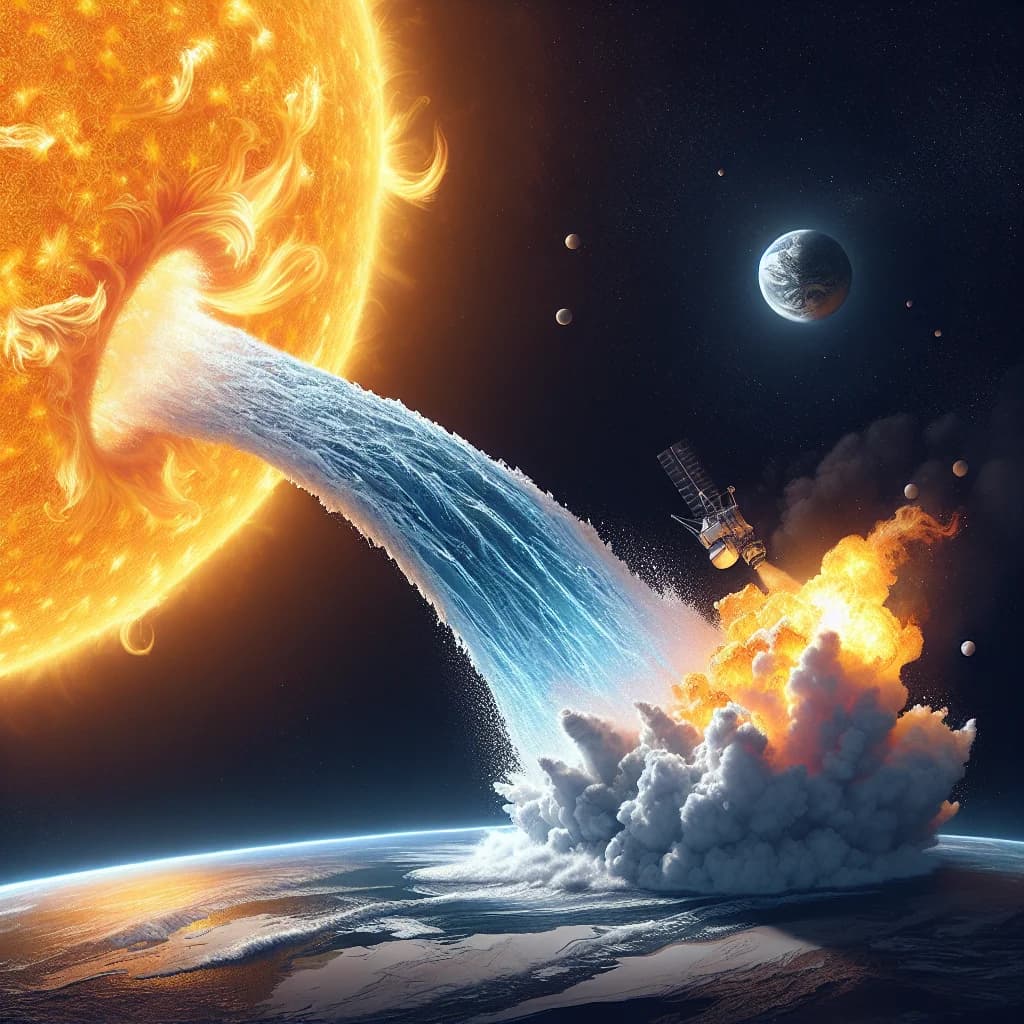
Imagine a cosmic fire brigade attempting the ultimate emergency response: quenching the Sun. In our everyday experience, water is the natural enemy of fire. If a campfire gets too rowdy, a bucket of water ends the party immediately. But what if we scaled this up to a celestial level? Picture a sphere of water the size of the Sun itself, hurtling through space to douse our local star. While your intuition might suggest a sudden, dark "hiss" and a cooling of the solar system, the laws of physics dictate a much more energetic—and ironically hotter—outcome.
To analyze this thought experiment, we must move away from the chemistry of a backyard grill and into the realms of nuclear physics and gravitational mechanics. This scenario isn't a battle of "wet versus dry," but rather a dramatic demonstration of how mass and gravity govern the life of a star.
The Solar "Fire" Misconception
The primary reason water fails to extinguish the Sun is that the Sun isn't actually "on fire" in the way we understand it on Earth. Terrestrial fire is a chemical reaction called combustion, which requires fuel (like wood), heat, and oxygen.
In contrast, the Sun is a giant nuclear fusion reactor. It generates energy by squeezing hydrogen atoms together under immense pressure and heat to form helium. This process doesn't require oxygen; it requires mass. When we introduce a massive volume of water to the Sun, we aren't introducing a cooling agent; we are introducing a massive delivery of raw materials.
Breaking Down the Water Molecule
Water is made of two hydrogen atoms and one oxygen atom ($H_2O$). As our hypothetical ocean approaches the Sun, the extreme temperatures—ranging from 5,500 degrees Celsius at the surface to 15 million degrees at the core—would instantly tear those water molecules apart.
- Hydrogen Addition: Since hydrogen is the primary fuel for stellar fusion, we are essentially giving the Sun a massive refill.
- Oxygen Contribution: While oxygen doesn't burn like wood, in massive stars, it acts as a catalyst in a process called the CNO cycle (Carbon-Nitrogen-Oxygen cycle), which further accelerates nuclear fusion.
Gravity: The Great Compressor
The most significant factor in this experiment is mass. In space, mass equals gravity. The Sun is already incredibly heavy, containing 99.8% of the mass in our solar system—equivalent to about 333,000 Earths. If we dumped an ocean of equal mass onto the Sun, we would double its total mass.
The Scaling Effect
When you double the mass of a star, the gravitational pull toward the center increases exponentially. This "gravitational hug" squeezes the core with significantly more intensity. According to the laws of stellar structure:
- Increased Pressure: The core is compressed further.
- Rising Temperature: As pressure increases, the kinetic energy of the atoms rises, spiking the core temperature.
- Accelerated Fusion: Because the core is hotter and denser, hydrogen atoms collide and fuse at a much faster rate.
Instead of cooling down, the Sun would undergo a "stellar upgrade." A star with twice the mass of our Sun doesn't just get twice as bright; it can become dozens of times more luminous.
The Transformation: A Brighter, Bluer Star
The immediate consequence of our cosmic splash would be a dramatic change in the Sun’s appearance and behavior. In the stellar classification system, our Sun is a yellow G-type star. By doubling its mass with water, we would likely push it into the territory of an A-type star.
- Color Shift: The Sun would shift from its familiar yellow hue to a brilliant, piercing blue-white.
- Energy Output: The total energy output (luminosity) would skyrocket, significantly increasing the radiation levels emitted into the solar system.
- Lifespan: Counter-intuitively, adding "fuel" (hydrogen) actually shortens a star's life. Like a sports car with a massive engine, the new, heavier Sun would burn through its resources at a frantic pace, potentially exhausting its fuel in hundreds of millions of years rather than the billions of years it currently has left.
Conclusion
The ultimate outcome of dumping a massive ocean onto the Sun is a spectacular backfire: the Sun would become larger, heavier, and significantly hotter. This hypothetical scenario highlights the core principle of astrophysics: mass is the ultimate destiny-maker for celestial bodies. While water is a cooling agent on a human scale, on a stellar scale, it is simply a collection of atoms subject to the irresistible force of gravity.
This thought experiment serves as a humbling reminder of the sheer power of nuclear fusion. It shows us that in the vast, energetic theater of the universe, our common-sense rules of chemistry are often rewritten by the overwhelming influence of gravity and the transformative power of the atom.