Why would humans have bright blue skin if our blood used copper instead of iron to carry oxygen
Imagine a world where your veins run with liquid sapphire and a simple blush turns your skin a striking, otherworldly cobalt. Explore the mind-bending science of copper-based blood and how a single elemental swap would have rewritten the human palette forever.

Too Long; Didn't Read
Human skin would appear bright blue because copper-based blood uses hemocyanin, which turns deep blue when oxygenated. Unlike iron-based hemoglobin that creates a reddish tint, hemocyanin would reflect blue light through our vessels and skin.
Blue Bloods: What Would Happen if Human Biology Swapped Iron for Copper?
Imagine walking through a bustling city where, instead of the warm pinks and deep browns of human complexions, every person you passed glowed with a striking shade of sapphire or teal. This isn't a scene from a fantasy novel; it is a fundamental question of biochemistry. What if the very foundation of our circulatory system—the iron-based protein that carries oxygen—was replaced by copper? By pivoting from hemoglobin to a copper-based alternative called hemocyanin, our entire biological presentation would shift. This thought experiment requires us to dive into the realms of molecular biology, evolutionary chemistry, and optics to understand why a simple change in metal would transform the human race into a "blue-blooded" species.
The Chemistry of Color: From Iron Red to Copper Blue
At the heart of our red blood is hemoglobin, a protein that uses iron ($Fe^{2+}$) to bind oxygen. When iron oxidizes, it reflects red light, much like the rust on an old bicycle. However, many mollusks and arthropods, such as horseshoe crabs, use hemocyanin. Instead of iron, hemocyanin utilizes two copper atoms to bind a single oxygen molecule.
The color change is a result of electronic transitions. When copper binds with oxygen, it shifts from a colorless, deoxygenated state ($Cu^+$) to a vibrant, oxygenated state ($Cu^{2+}$). This oxygenated copper absorbs longer wavelengths of light and reflects the shorter, high-energy blue wavelengths. Consequently, if a human’s circulatory system were powered by hemocyanin, our arterial blood would be a brilliant, saturated blue.
The Efficiency Gap: Oxygen and Energy
In a hypothetical "copper-based" human, the primary challenge would be energy efficiency. Hemoglobin is an evolutionary masterpiece for warm-blooded mammals. A single hemoglobin molecule can carry four oxygen molecules, whereas hemocyanin typically binds oxygen less efficiently in high-temperature environments.
To maintain our current metabolic rate, a copper-based human would require significant physiological adjustments:
- Volumetric Scaling: Because hemocyanin generally carries about 25% to 50% less oxygen per unit of volume than hemoglobin in warm-blooded conditions, our hearts would need to pump significantly more fluid.
- Viscosity: Hemocyanin molecules are massive compared to hemoglobin and often float freely in the plasma rather than being packed into red blood cells. To avoid blood as thick as syrup, our vessels would likely need to be wider to accommodate the increased volume and pressure required to move this blue fluid.
The Visual Result: The Cerulean Human
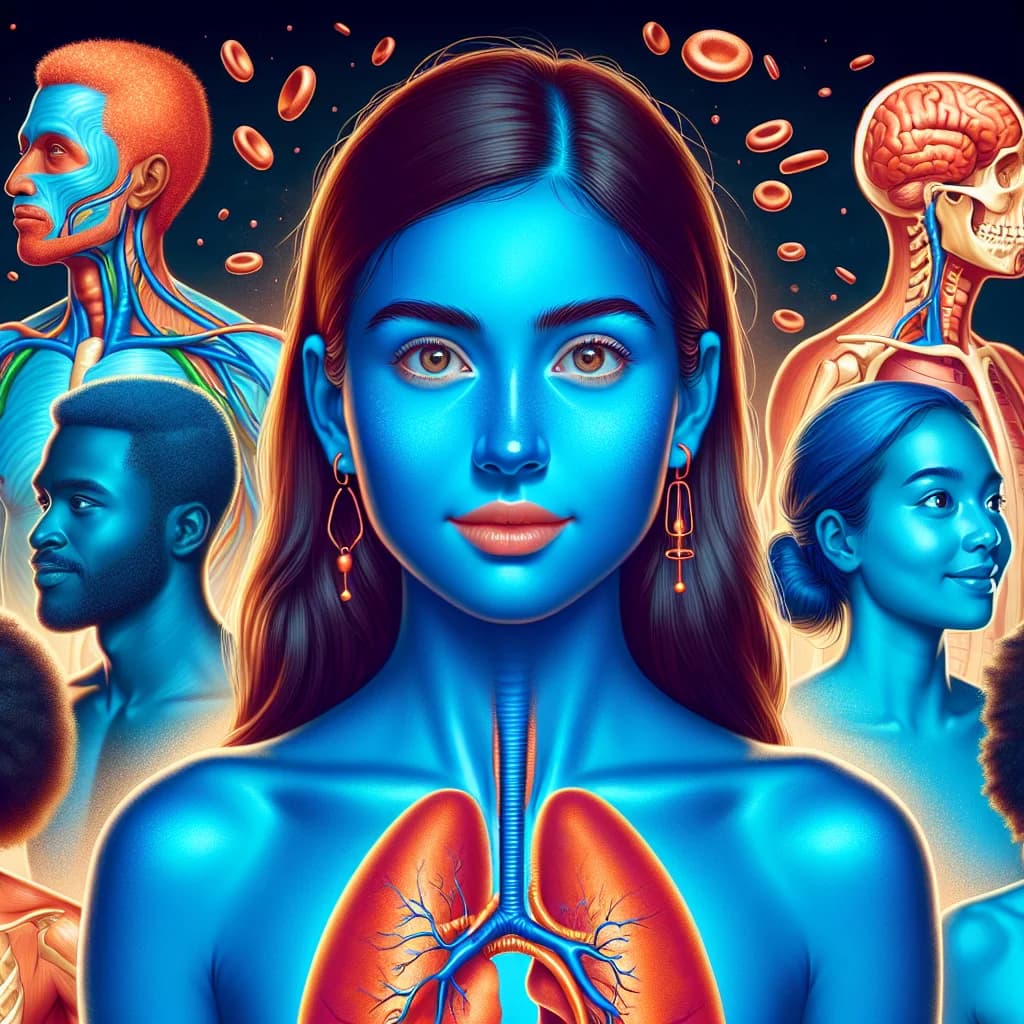
Why would our skin appear blue? Human skin is somewhat translucent. The color we see is a combination of melanin pigment and the blood vessels beneath the surface. If our blood were bright blue, the "flush" of our skin would change entirely.
- Cyanosis as a Constant: In our current biology, "turning blue" (cyanosis) is a sign of oxygen deprivation. In a copper-based human, a blue tint would be the hallmark of peak health.
- Blushing and Temperature: When we exercise or feel embarrassed, our capillaries dilate to move blood closer to the skin’s surface for cooling or as a social signal. Instead of a rosy glow, a copper-based human would exhibit a deep indigo or cobalt flush.
- The Absence of Red: Without iron-based blood, the warm undertones of the human palette would vanish, replaced by a spectrum ranging from pale sky blue to deep navy, depending on the concentration of melanin.
Environmental Constraints
If humans were copper-based, we would likely have evolved in a very different environment. Hemocyanin is actually superior to hemoglobin in cold, low-oxygen environments, such as the deep ocean.
If we applied the laws of thermodynamics to this scenario, a blue-blooded human would likely have a much lower resting body temperature. Our high-energy, warm-blooded lifestyle is perfectly fueled by the rapid oxygen-delivery system of iron. Switching to copper might turn us into a slower-moving, "cold-blooded" species, better suited for life in a chilly, high-pressure environment rather than a sun-drenched savannah.
Conclusion
The hypothetical transition from iron to copper blood reveals the stunning precision of evolutionary biology. While the image of a bright blue human population is aesthetically captivating, it highlights how deeply our physical appearance is tied to the chemical efficiency of our internal systems. Our red blood is not just a color; it is a high-speed delivery service that allows our large brains and warm bodies to function.
This thought experiment reminds us that we are walking tapestries of the periodic table. Whether it is the iron in our blood or the calcium in our bones, the elements we carry dictate the very colors of our lives, proving that even the smallest change at the molecular level can rewrite the visual story of a species.