Why would injecting iron into the core of a massive star cause it to explode almost instantly
Iron is the ultimate "energy vampire" for stars, acting as a cosmic self-destruct button that can trigger a supernova in the blink of an eye. Discover how injecting this single element forces a celestial giant to collapse under its own weight, sparking the most violent explosion in the universe.

Too Long; Didn't Read
Stars survive by fusing elements to create outward pressure that counters gravity. Iron is the ultimate energy sink because fusing it consumes energy rather than releasing it. Introducing iron instantly halts the star’s energy production, causing the core to collapse under its own weight and trigger a supernova explosion.
The Iron Dead-End: What Happens if You Inject the Ultimate "Stellar Poison" into a Massive Star?
Imagine a celestial engine so powerful it can forge atoms, yet so fragile that a sudden influx of a common metal could cause its total structural failure in less than a second. In the vast laboratory of the cosmos, massive stars serve as the ultimate pressure cookers, maintaining a delicate balance between the crushing force of gravity and the explosive power of nuclear fusion. However, there is one element that acts as a thermodynamic "off switch": iron. While it may seem counterintuitive that adding matter to a star could cause it to vanish in a flash of light, the physics of nuclear binding energy tells a different story. By exploring the realms of astrophysics and quantum mechanics, we can analyze why injecting iron into a star’s core is essentially handing a "quit notice" to one of the universe's most powerful objects.
The Delicate Balance: Gravity vs. Fusion
To understand why iron is so dangerous, we must first look at how a star survives. A massive star is a constant tug-of-war between two titanic forces:
- Gravity: The immense mass of the star (often 10 to 20 times the mass of our Sun) wants to pull everything toward the center, crushing the core into a singularity.
- Radiation Pressure: In the core, the fusion of lighter elements into heavier ones releases a staggering amount of energy. This outward pressure acts like a thermal "cushion," holding gravity at bay.
This state is known as hydrostatic equilibrium. As long as the star has fuel to fuse, the cushion remains firm. For millions of years, the star fuses hydrogen into helium, then helium into carbon, and so on, moving up the periodic table. Each step releases the energy required to keep the star inflated.
The Nuclear Binding Energy Cliff
The reason iron is "poisonous" to this process lies in the concept of nuclear binding energy. Think of atoms like building blocks. When you fuse light blocks (like hydrogen) together, they settle into a more stable state and release "tax" energy in the process. This is an exothermic reaction.
However, iron-56 is the most stable atomic nucleus in the universe. It sits at the very peak of the binding energy curve. Because it is already at the maximum state of stability:
- Fusing iron into heavier elements does not release energy.
- Instead, fusing iron consumes energy.
In scientific terms, the reaction becomes endothermic. If you were to inject a significant amount of iron into the core, you aren't providing more fuel; you are introducing a "heat sink" that starts absorbing the very energy meant to hold the star up.
The Mechanics of an Instant Shutdown
If a massive quantity of iron were suddenly injected into the core of a star nearing the end of its life, the consequences would be nearly instantaneous. Here is the cascading physical sequence:
- Pressure Loss: The iron begins to absorb thermal energy and high-energy photons. The outward radiation pressure, which was previously counteracting millions of tons of gravitational force, vanishes.
- The Great Inward Rush: With the "cushion" gone, gravity wins the tug-of-war instantly. The outer layers of the star begin to fall inward at roughly 25% the speed of light.
- Core Compression: The core reaches densities so high that electrons and protons are crushed together to form neutrons, creating a neutron star or a black hole.
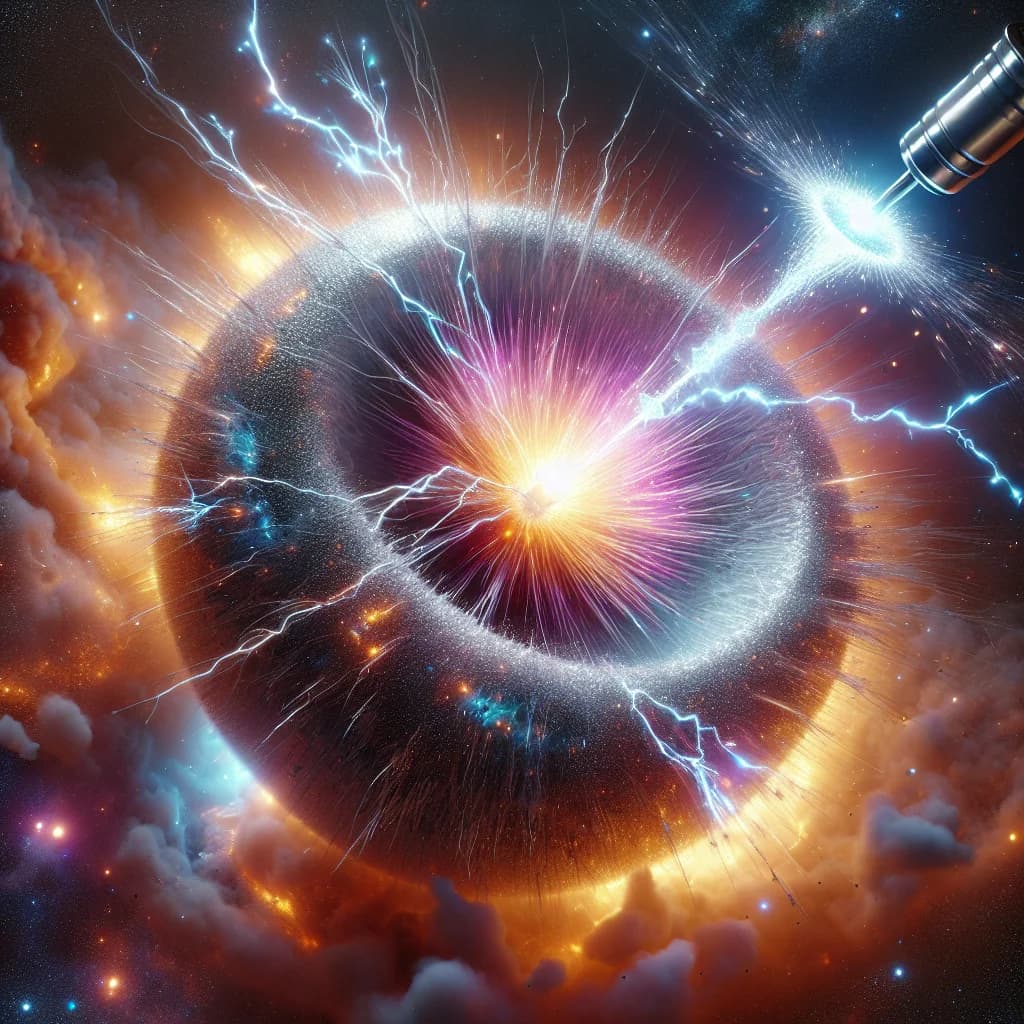
- The Kinetic Bounce: The infalling outer layers hit this new, ultra-dense core and "bounce" off it. This creates a shockwave that moves outward, resulting in a Type II Supernova.
To put this scale into perspective, the energy released in this "bounce" is more than our Sun will produce in its entire 10-billion-year lifetime, all concentrated into a few seconds of brilliant, clinical destruction.
Conclusion
Ultimately, injecting iron into the core of a massive star causes an explosion because it disrupts the fundamental energy economy of the cosmos. By introducing an element that requires energy to process rather than providing it, you effectively remove the structural support holding the star together. Gravity, ever-present and relentless, takes over in a fraction of a second, leading to a rapid reconfiguration of matter known as a supernova. This thought experiment highlights the fascinating reality of our universe: the very same laws of physics that allow stars to shine also dictate their inevitable conclusion. While iron acts as the "dead-end" for a star, the resulting explosion scatters all the other elements necessary for life across the galaxy, proving that even in a stellar collapse, nothing is truly lost.