Why would it be physically impossible for a magnifying glass to heat anything to a temperature hotter than the Sun
Think you can outheat the Sun with a giant lens? Discover the mind-bending law of physics that creates an unbreakable "temperature ceiling," proving why a simple magnifying glass can never be hotter than the star that powers it.

Too Long; Didn't Read
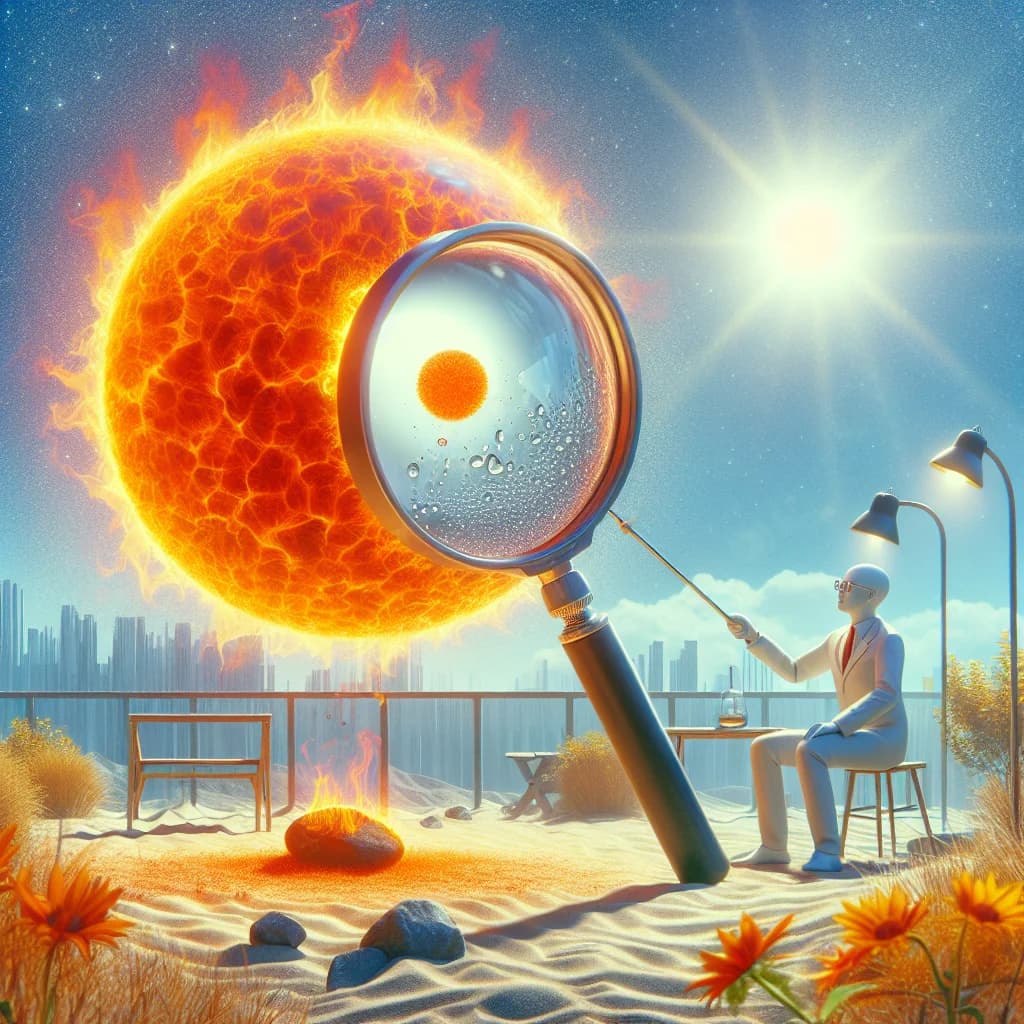
According to the second law of thermodynamics, heat cannot spontaneously flow from a colder object to a hotter one. A magnifying glass concentrates sunlight but cannot increase the surface brightness of the source. Therefore, an object can only reach thermal equilibrium with the Sun's surface temperature, as it will eventually radiate energy away as fast as it absorbs it.
Can You Outburn the Sun? The Surprising Physics Why Magnifying Glasses Have a Temperature Ceiling
We have all seen the classic science experiment: holding a magnifying glass over a dry leaf until a tiny, brilliant bead of light appears, followed quickly by a wisp of smoke. In that moment, it feels as though we are wielding a fragment of infinite power. If a small handheld lens can char wood, it seems logical to assume that a massive, building-sized lens could create a point of heat so intense it rivals or even surpasses the stars. However, physics steps in with a firm "no." No matter how large your lens is or how perfectly you craft it, you can never use passive sunlight to heat an object to a temperature higher than the surface of the Sun itself.
This fascinating limitation isn't due to a lack of engineering skill, but rather the fundamental constraints of the Second Law of Thermodynamics and the geometric properties of light, known as the conservation of etendue.
The Thermodynamic "Hard Stop"
To understand why we cannot beat the Sun at its own game, we must first look at the Second Law of Thermodynamics. In its simplest form, this law dictates that heat will spontaneously flow from a hotter object to a colder one, but never the other way around without adding extra work.
The surface of the Sun, known as the photosphere, sits at a blistering temperature of approximately 5,500 degrees Celsius (about 9,900 degrees Fahrenheit). When you use a magnifying glass, you are essentially creating a bridge for energy to travel from the Sun to your target. As the target heats up, it begins to radiate its own energy back out into the environment.
If the target were to reach 5,501 degrees Celsius—just one degree hotter than the Sun—the flow of energy would flip. The target would begin "heating" the Sun. In a passive system (one where you aren't adding extra electricity or fuel), a cooler object cannot make a warmer object even hotter. The system naturally seeks an equilibrium where the temperatures match, but never cross.
The Geometry of Light: It’s All About the Image
A magnifying glass does not actually "scrunch" light rays into a single, infinitesimal point. Instead, it creates a very small, very bright image of the Sun. If you look closely at the "dot" produced by a lens, you are actually looking at a tiny projection of the solar disk.
The Radiance Constraint
In optics, there is a rule called the conservation of radiance (or etendue). This principle states that no optical system can make a light source appear brighter than it originally is.
- The Perspective Shift: Imagine standing on the surface of the Sun. Everywhere you look, you see blindingly hot plasma at 5,500°C.
- The Lens Effect: The most a giant magnifying glass can do is "wrap" the image of the Sun around your target. Even if you built a lens so large that it surrounded your target from every single angle, the target would simply feel like it was sitting inside the Sun’s photosphere.
- The Limit: Since the target cannot "see" anything brighter than the Sun’s surface, it cannot absorb enough energy to surpass the Sun’s temperature.
Visualizing the Scale
To put this in perspective, consider the sheer volume of energy we are discussing. The Sun’s surface temperature is enough to vaporize any known solid material on Earth.
- Massive Lenses: If you had a lens the size of a football stadium, you would certainly reach that 5,500°C limit much faster and over a larger area, but you would still hit that invisible thermal wall.
- Environmental Consequences: At these temperatures, the air around the focal point would instantly turn into a glowing plasma. The molecules of oxygen and nitrogen would be stripped of their electrons, creating a brilliant, clinical flash of light as the atmosphere itself is energized.
- Physical Limitations: Any target you place in that beam—be it steel, diamond, or tungsten—would transition from a solid to a liquid and then to a gas in a matter of milliseconds.
While the "destruction" is spectacular in a scientific sense, it is limited by the fact that the target can only ever be as "excited" as the photons hitting it. Since those photons originated from a 5,500°C source, they simply don't carry the "punch" required to push a target to 6,000°C or beyond.
Conclusion
The dream of creating a "super-solar" hot spot with a simple magnifying glass is ultimately thwarted by the fundamental rules of our universe. Because heat cannot flow from cold to hot and optics cannot increase the inherent brightness of a source, the Sun’s surface temperature remains the ultimate speed limit for solar concentrators.
This thought experiment highlights the beautiful symmetry of physics: the same laws that prevent us from out-heating the Sun also ensure that energy in our universe moves in predictable, orderly ways. While we might not be able to break the 5,500°C barrier with a lens, the fact that we can even reach such temperatures using nothing but a curved piece of glass and a star 93 million miles away is a testament to the incredible power of the cosmos.