Why would plants on a planet orbiting a red dwarf star likely evolve to have jet black leaves
Forget the vibrant greens of Earth—in the dim glow of a red dwarf sun, survival demands a much darker palette. Discover why alien flora would likely evolve obsidian leaves to drink in every last drop of infrared energy.

Too Long; Didn't Read
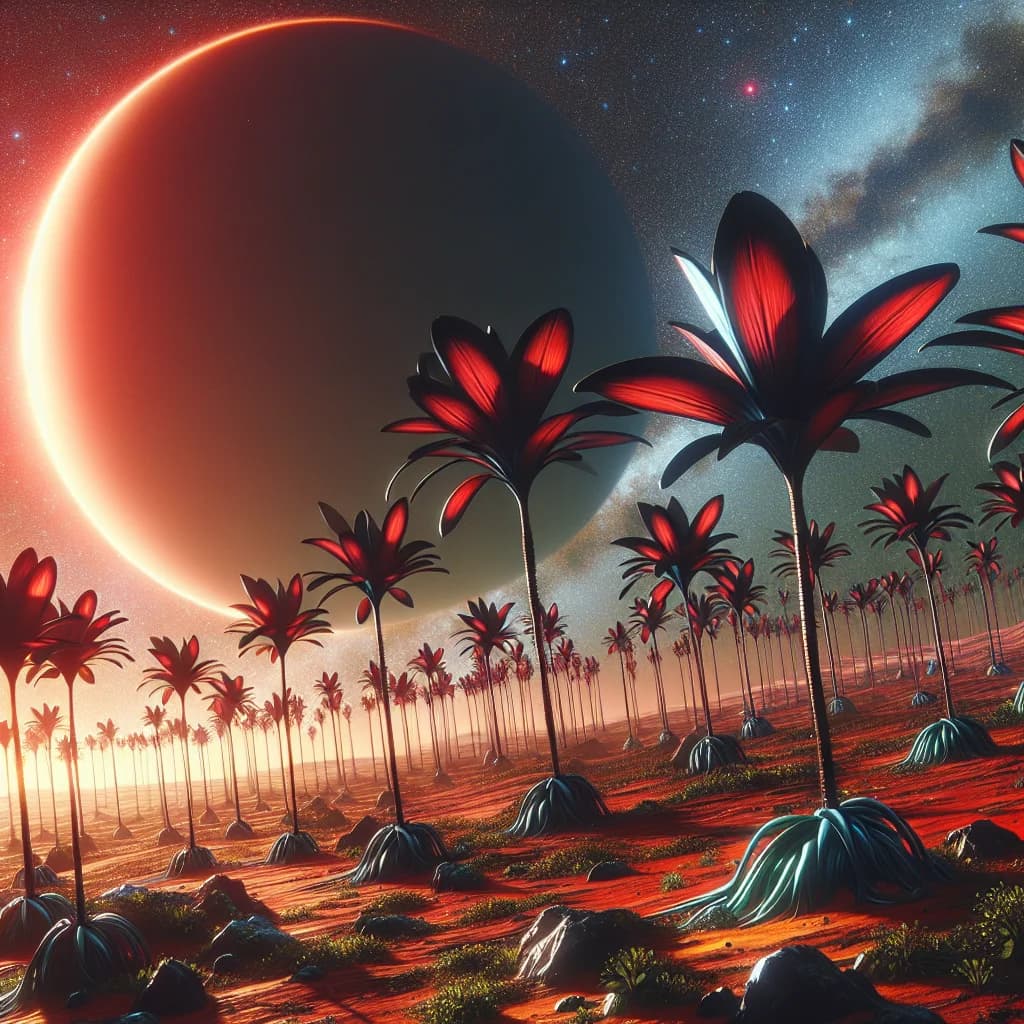
Plants orbiting red dwarf stars would likely evolve black leaves to maximize energy absorption. Because these stars emit most of their radiation in the cooler red and infrared spectrums, black foliage allows plants to capture all available light wavelengths for photosynthesis rather than reflecting specific colors.
Beyond Green: Why Would Plants on a Red Dwarf Planet Evolve Jet Black Leaves?
Imagine stepping onto an alien world where the "great outdoors" looks like a scene from a noir film. Instead of the lush, rolling greens we associate with Earth’s meadows, you find yourself surrounded by foliage as dark as a starless midnight. This isn't a gothic fantasy; it is a legitimate scientific hypothesis. When we look at the most common stars in our galaxy—red dwarfs—the laws of physics and biology suggest that any local flora would likely trade in their emerald hues for a coat of jet black.
This thought experiment relies on the intersection of stellar astrophysics, photonics, and evolutionary biology. By analyzing how light interacts with matter, we can predict how life might adapt to a sun that looks and behaves very differently from our own.
The Dim Glow of an M-Dwarf Star
To understand the color of alien plants, we must first look at their light source. Red dwarfs, or M-dwarfs, are smaller and cooler than our Sun. While our Sun has a surface temperature of about 5,800 Kelvin, a red dwarf typically smolders at a cooler 2,500 to 3,500 Kelvin.
Because of this temperature difference, the "color palette" of the light reaching a planet is shifted. Our Sun peaks in the yellow-green part of the visible spectrum, which is why Earth's plants have evolved to be so efficient at utilizing that energy. In contrast, a red dwarf emits most of its energy in the long-wavelength red and near-infrared parts of the spectrum. To a human eye, these stars would appear as a dull, glowing ember rather than a brilliant white-yellow orb.
The Thermodynamics of "Catching" Light
On Earth, plants are green because chlorophyll reflects green light while absorbing blue and red light to power photosynthesis. This "pickiness" is a luxury afforded by our Sun’s high energy output. However, on a planet orbiting a red dwarf, energy is at a premium.
- Photon Scarcity: Red dwarf photons have lower energy than the "high-octane" ultraviolet and blue photons from our Sun.
- Maximum Absorption: To gather enough energy to fuel chemical reactions, an alien plant would need to be an "energy sponge."
- The Color of Efficiency: When a material absorbs all wavelengths of visible light without reflecting any, it appears black to our eyes.
By evolving pigments that absorb across the entire visible spectrum—and even into the infrared—these plants would maximize their caloric intake from a dim sun. Just as a black asphalt road absorbs more heat than a white sidewalk, a black leaf absorbs more photons than a green one.
Adapting to the Infrared
The most fascinating aspect of this evolutionary path is the move into the infrared. Over 90% of a red dwarf’s light output is in the infrared range, which humans perceive only as heat.
- Multi-Photon Photosynthesis: Alien plants might use a process where they combine the energy of two or three low-energy infrared photons to trigger a single chemical reaction that normally requires one high-energy "blue" photon.
- Thermal Management: Being jet black helps with energy absorption, but it also helps the plant maintain a stable internal temperature in a world that might otherwise be quite chilly.
The Influence of Tidal Locking
Most habitable planets around red dwarfs are "tidally locked," meaning one side always faces the star. In this eternal afternoon, there is no "night" for plants to rest or "morning" for them to wake up. They are under constant, low-intensity bombardment by red and infrared light. This reinforces the need for a permanent, high-efficiency absorption strategy. There is no evolutionary advantage to reflecting any light at all when the light source is already so faint.
Conclusion
The high-probability existence of black-leaved plants highlights the incredible flexibility of life. The ultimate scientific outcome of this scenario is driven by the principle of energy optimization: life will always evolve to fill the gaps of its environment as efficiently as possible. Because red dwarfs provide a "low-energy" diet of light, plants would likely evolve to be the ultimate solar collectors, absorbing every scrap of radiation available.
While we often view our green Earth as the universal standard for life, the physics of light suggests we are the exception. In the vastness of the Milky Way, the "typical" forest is likely not green at all, but a shimmering, beautiful sea of deepest black. This reminds us that while the laws of physics are universal, the expressions of life are as varied as the stars themselves.