Why would the extreme atmospheric refraction on Venus allow you to see the back of your own head
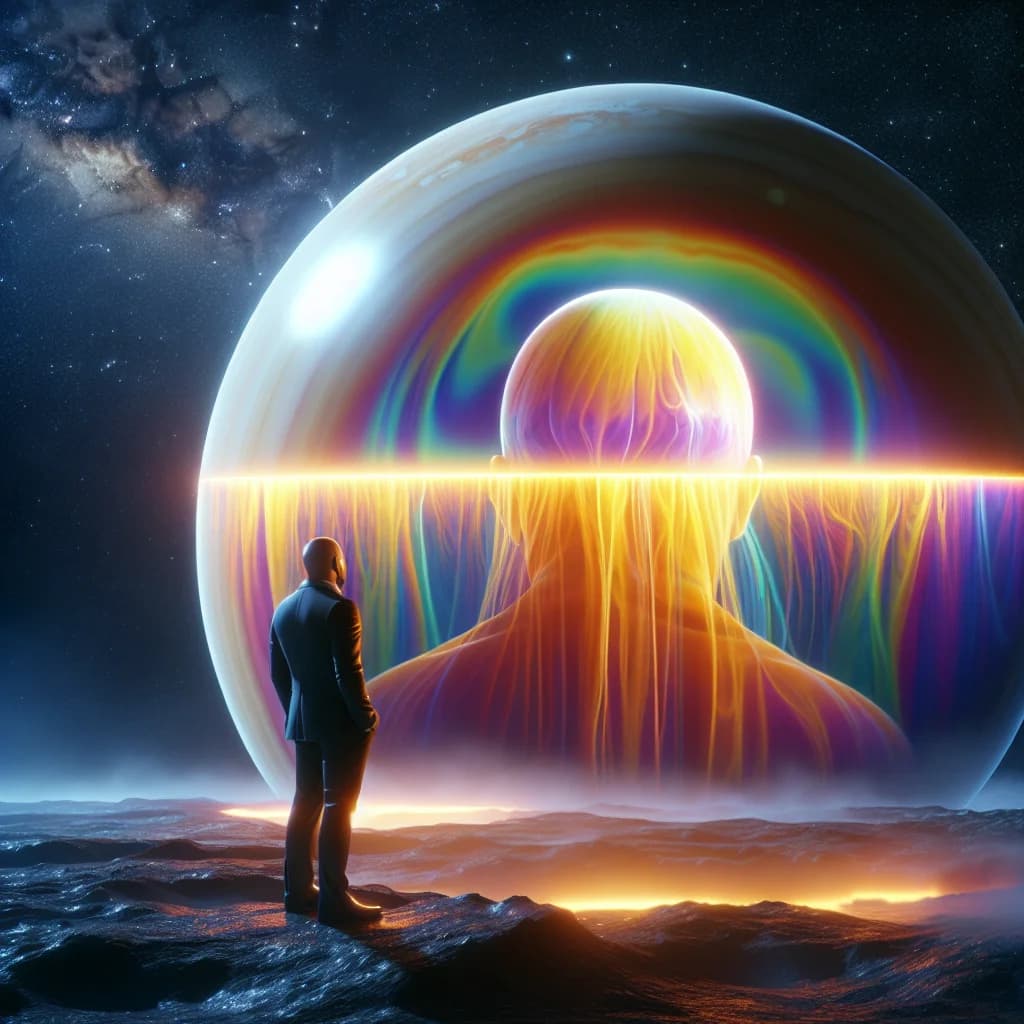
Imagine looking toward the horizon and seeing the back of your own head staring back at you. On Venus, the atmosphere is so incredibly dense that it actually bends light into a circle, turning the entire planet into a surreal, physics-defying hall of mirrors.

Too Long; Didn't Read
Venus's incredibly dense atmosphere creates such extreme atmospheric refraction that light is bent into a curve matching the planet's circumference. This phenomenon theoretically allows light reflecting off the back of your head to travel around the entire planet and return to your eyes.
The Venusian Hall of Mirrors: Could Extreme Refraction Let You See the Back of Your Head?
Imagine standing on a landscape where the horizon does not dip away into the distance, but instead appears to curve upward, wrapping around you like the interior of a vast, golden bowl. In the strange, high-pressure environment of Venus, the laws of optics are pushed to such an extreme that the path of a photon is no longer a straight line, but a dedicated curve. This leads to a mind-bending theoretical possibility: if you stood in the right spot, could the light reflecting off the back of your head travel around the entire planet and return to your eyes?
To analyze this hypothetical scenario, we must dive into the realms of atmospheric optics and fluid dynamics. By examining the refractive index of supercritical carbon dioxide and the specific density gradients of the Venusian atmosphere, we can determine if this "spherical mirage" is a physical reality or merely a mathematical curiosity.
The Pressure Cooker Lens: Understanding Venusian Density
The primary reason Venus behaves like a giant glass lens is its staggering atmospheric density. At the surface, the pressure is approximately 92 bar—roughly equivalent to being 900 meters (3,000 feet) underwater on Earth. This atmosphere is composed almost entirely of carbon dioxide ($CO_2$).
In physics, the "refractive index" ($n$) of a gas increases as its density increases. On Earth, our air is thin enough that $n$ is very close to 1.00029, meaning light bends only slightly. On Venus, however:
- The surface density is roughly $65 kg/m^3$, which is about 50 times denser than Earth’s air.
- Because the gas is so compressed, it begins to behave less like a typical gas and more like a "supercritical fluid."
- This creates a massive refractive gradient, where the air nearest the ground is significantly "thicker" for light than the air just a few meters higher.
Snell’s Law on a Global Scale
When light moves through an atmosphere with a changing density, it bends toward the denser medium—a process known as refraction. On Venus, this bending is so severe that it fights against the natural curvature of the planet.
The Critical Radius
For you to see the back of your head, the curvature of the light beam must match the curvature of Venus itself. The radius of Venus ($R_v$) is approximately 6,052 kilometers. Using the principles of the Gladstone-Dale relation, we can estimate the path of light:
- Refractive Gradient: As altitude increases, density drops sharply. This creates a steep vertical gradient in the refractive index.
- The Bending Ratio: On Earth, the atmosphere bends light by about 1/6th of the planet's curvature. On Venus, the bending exceeds 1/1 (the "critical refraction" point).
- The Result: Light rays emitted horizontally do not escape into space; instead, they are trapped in a curved path that hugs the surface.
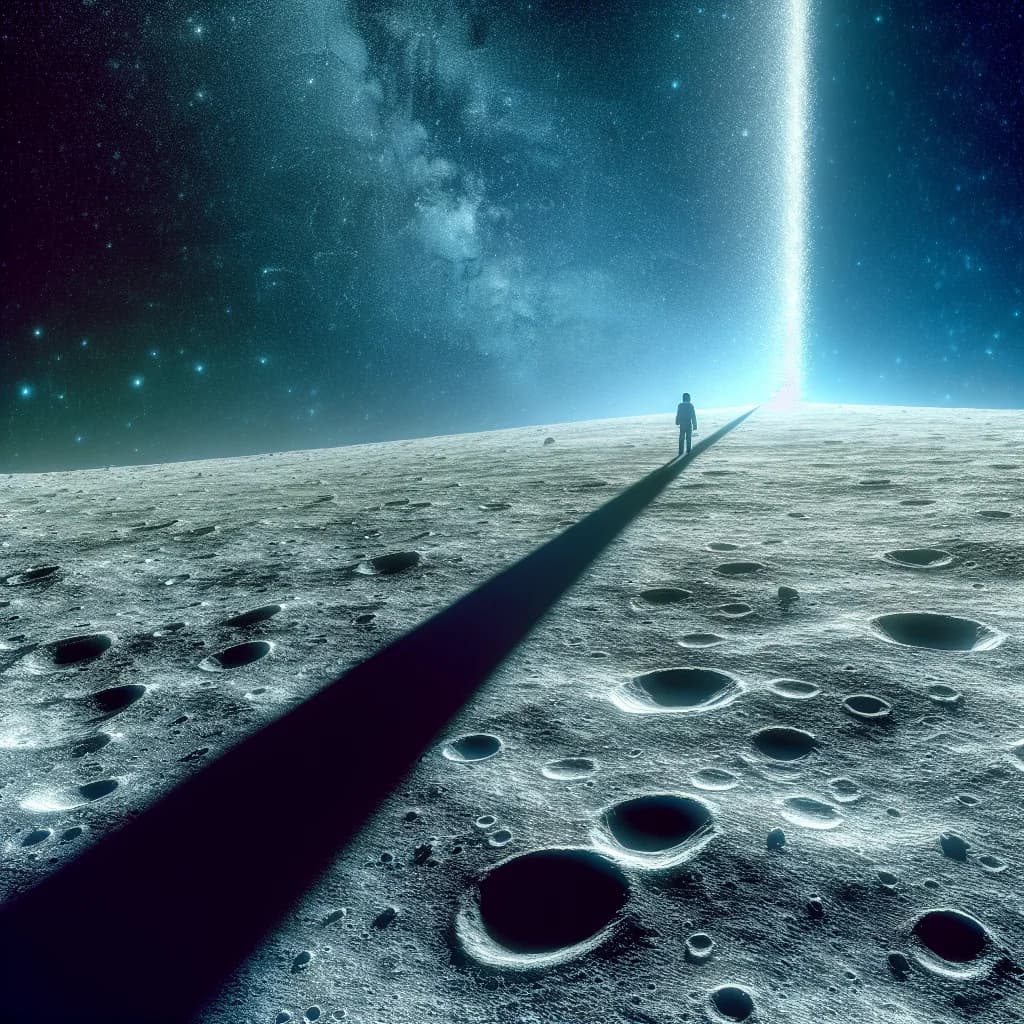
In theory, if you were to look straight ahead, you wouldn't see the horizon. You would see the ground "rising" to meet your eye level, potentially allowing a beam of light to orbit the planet entirely.
The Atmospheric Obstacle Course
While the math suggests light can curve around the planet, several physical constraints act as "filters" for our experiment.
Rayleigh Scattering: The Orange Fog
Even if a photon from the back of your head begins its 38,000-kilometer journey around Venus, it faces a gauntlet of molecules. Rayleigh scattering—the same phenomenon that makes Earth’s sky blue—is much more intense in a dense atmosphere.
- Color Shift: Shorter wavelengths (blue and green) are scattered almost immediately.
- The "Vanish" Point: By the time light traveled even a few dozen kilometers, most of it would be scattered into a generic orange-red glow.
Molecular Absorption
Venus’s atmosphere is not perfectly transparent. The high concentration of $CO_2$ and trace sulfur compounds are excellent at absorbing specific wavelengths of light. To see your own head, the light would need to survive an incredibly long trek through a "thick" medium without being absorbed by a single molecule of gas or a droplet of sulfuric acid.
The Visual Reality: What Would You Actually See?
If we ignore scattering for a moment, the visual experience on Venus would be unlike anything on Earth.
- The Bowl Effect: Because light curves downward toward the surface, your brain would interpret the light as coming from "above." This creates the illusion that you are standing at the bottom of a massive pit.
- Infinite Magnification: Objects in the distance would appear stretched and distorted.
- The Ghostly Self: If the atmosphere were perfectly clear, you might see a shimmering, highly distorted, and extremely dim version of yourself appearing on the distant "horizon."
Conclusion
The extreme atmospheric refraction of Venus presents a fascinating case study in planetary physics. Mathematically, the density of the Venusian atmosphere is high enough to bend light into a circle that matches the planet's circumference, theoretically allowing a person to see the back of their own head. However, the realities of Rayleigh scattering and molecular absorption mean that, in practice, the light would likely blur into a hazy, monochromatic glow long before it completed its global lap.
This thought experiment reminds us that the most basic elements of our daily lives—like light traveling in a straight line—are not universal constants. They are products of our specific environment, proving that across the cosmos, even the act of looking forward can be a journey that leads you right back to where you started.