Why would the magnetic field of a magnetar stretch every atom in your body into a thin needle
In the grip of a magnetar, the fundamental laws of chemistry collapse as magnetic forces warp your very atoms into long, thin needles. Discover the terrifying science behind the universe’s most powerful magnets and what they would actually do to the human body.

Too Long; Didn't Read
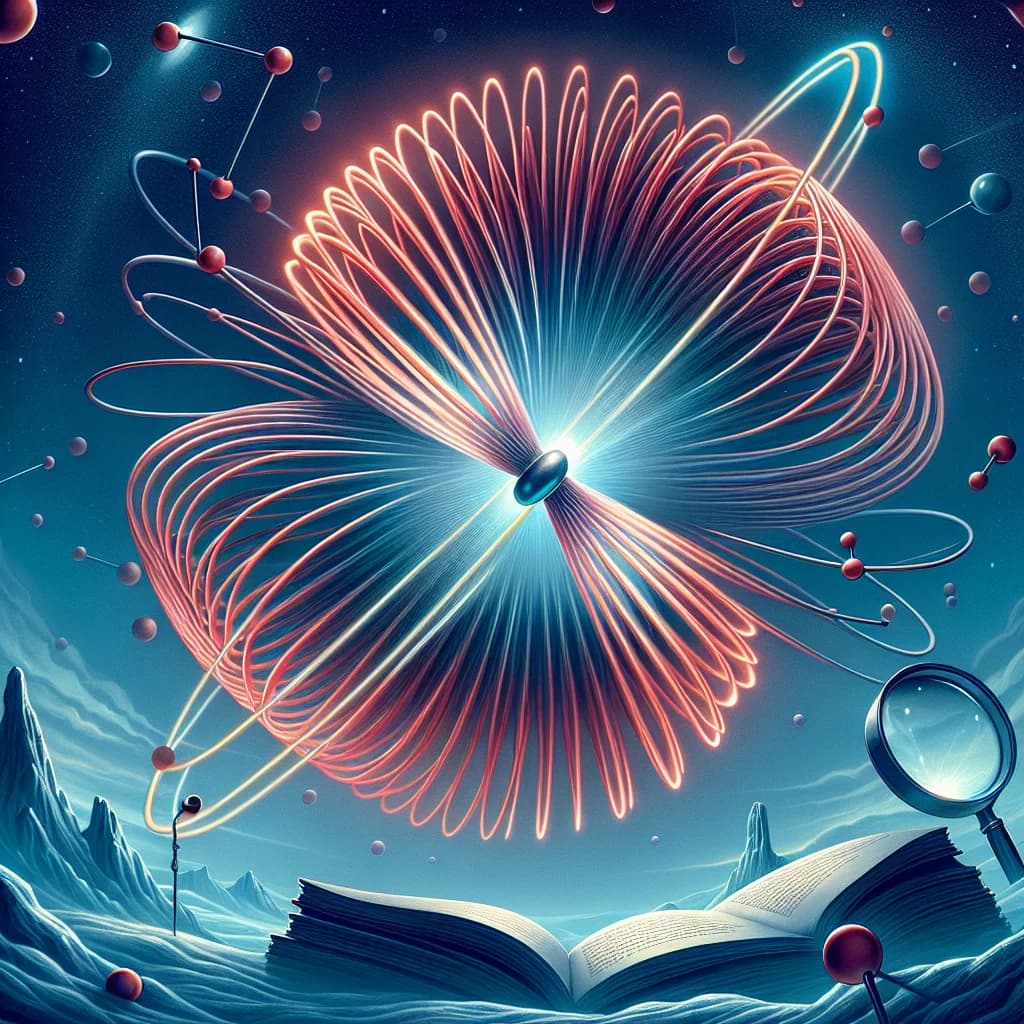
Magnetars possess magnetic fields quadrillions of times stronger than Earths. This intense force overwhelms the electrostatic bonds that normally hold atoms together, compressing electron clouds and forcing them to align with the magnetic field lines. As a result, spherical atoms are crushed into long, thin cylinders, stretching every molecule in your body into a microscopic needle.
Could a Magnetar Really Stretch Your Atoms into Tiny Needles? The Science of Extreme Magnetic Fields
Imagine a magnet so powerful that it could rearrange the very building blocks of your body from a distance of thousands of miles. In the vast, silent theater of the cosmos, there exists a class of neutron stars known as magnetars that possess exactly this kind of influence. While we often think of magnets as simple tools for holding notes on a refrigerator, the magnetic field of a magnetar is a force of nature that defies everyday logic. This thought experiment explores what happens when the fundamental laws of atomic physics meet the most intense magnetic environments in the universe. By applying the principles of quantum mechanics and electromagnetism, we can analyze how these stellar remnants would theoretically reshape human biology into a collection of microscopic, needle-like structures.
The Magnitude of a Magnetar’s Might
To understand why a magnetar would stretch your atoms, we must first appreciate the staggering scale of its power. A magnetar is a neutron star with a magnetic field roughly 1,000 trillion times stronger than Earth’s.
- Earth’s Magnetic Field: Approximately 0.00003 Tesla.
- Standard Hospital MRI: Approximately 1.5 to 3 Tesla.
- A Magnetar’s Field: Approximately 10,000,000,000 Tesla.
At these levels, the magnetic energy density is so high that it begins to exceed the rest-mass energy of the vacuum itself. If you were to bring a magnetar within 100,000 miles of Earth, it would instantly erase the data on every credit card and hard drive on the planet. However, the truly fascinating effects occur at the level of the atom, where the magnetic force begins to compete with the electrostatic forces that hold matter together.
Overpowering the Electrostatic Bond
In our everyday environment, the shape of an atom is dictated by the attraction between the positively charged nucleus and the negatively charged electrons. Electrons reside in "clouds" or orbitals that are generally spherical or lobe-shaped. These shapes are maintained because the electrical pull of the nucleus is the dominant force at play.
However, when an atom enters the vicinity of a magnetar, the magnetic field becomes the "alpha" force. This transition occurs because of the Lorentz force, which dictates how charged particles move in a magnetic field. In a field of 10 billion Tesla, the magnetic pressure becomes so immense that it compresses the electron clouds.
The Transition to Needle-Like Atoms
- Lateral Compression: The magnetic field exerts a massive inward pressure perpendicular to the field lines. This squeezes the electron orbitals into incredibly narrow cylinders.
- The Larmor Radius: Electrons are forced to spin in extremely tight circles around the magnetic field lines. At magnetar strengths, this radius becomes smaller than the atom's typical size.
- Elongation: While the atoms are squeezed thin horizontally, they remain relatively extended along the direction of the magnetic field lines.
The result is a radical transformation: atoms that were once roughly spherical become thin, elongated cylinders—effectively, tiny needles. Estimates suggest these "magnetized atoms" could be 100 to 1,000 times longer than they are wide.
The End of Conventional Chemistry
The consequences of this atomic reshaping are profound for human biology. Our bodies rely on complex chemistry—proteins folding, DNA replicating, and signals firing across neurons. All of these processes depend on the specific shapes of molecules.
Molecular Dissociation
Chemical bonds are formed when atoms share or exchange electrons in specific geometric patterns. When a magnetar stretches an oxygen or carbon atom into a needle, those "shared" electron paths are obliterated.
- Bond Failure: Molecules like water ($H_2O$) or glucose would lose their structural integrity.
- Structural Realignment: Instead of complex organic shapes, the atoms would likely align in long, polymer-like chains following the magnetic field lines.
- Clinical Transformation: From a scientific perspective, the body would undergo "molecular dissociation." The biological "you" would cease to function as a chemical system and instead become a collection of aligned atomic filaments.
A Universe of Extreme Physics
The hypothetical scenario of approaching a magnetar illustrates the delicate balance of forces that allow life to exist. On Earth, we live in a "low-field" environment where chemistry is governed by the gentle dance of electrons. In the realm of a magnetar, the rules of the game change entirely, moving from the predictable world of biology to the high-energy frontier of quantum electrodynamics.
In summary, the magnetic field of a magnetar is so intense that it overrides the internal electrical forces of an atom. This causes electron clouds to collapse into narrow cylinders, stretching every atom in the vicinity into a microscopic needle. While this sounds like the plot of a science fiction novel, it is a rigorous prediction of how matter behaves under extreme cosmic pressure. This thought experiment serves as a brilliant reminder that our understanding of "solid" matter is entirely dependent on the environment in which we observe it, highlighting the magnificent and sometimes strange diversity of the universe.