Why would the Moon appear completely black if its surface were replaced by a perfect giant mirror
You might expect a mirrored Moon to be a dazzling beacon, but the reality is far more haunting: it would effectively vanish into a light-swallowing void. Discover the mind-bending physics behind why a perfect reflection would turn our brightest night light into a terrifying hole in the sky.

Too Long; Didn't Read
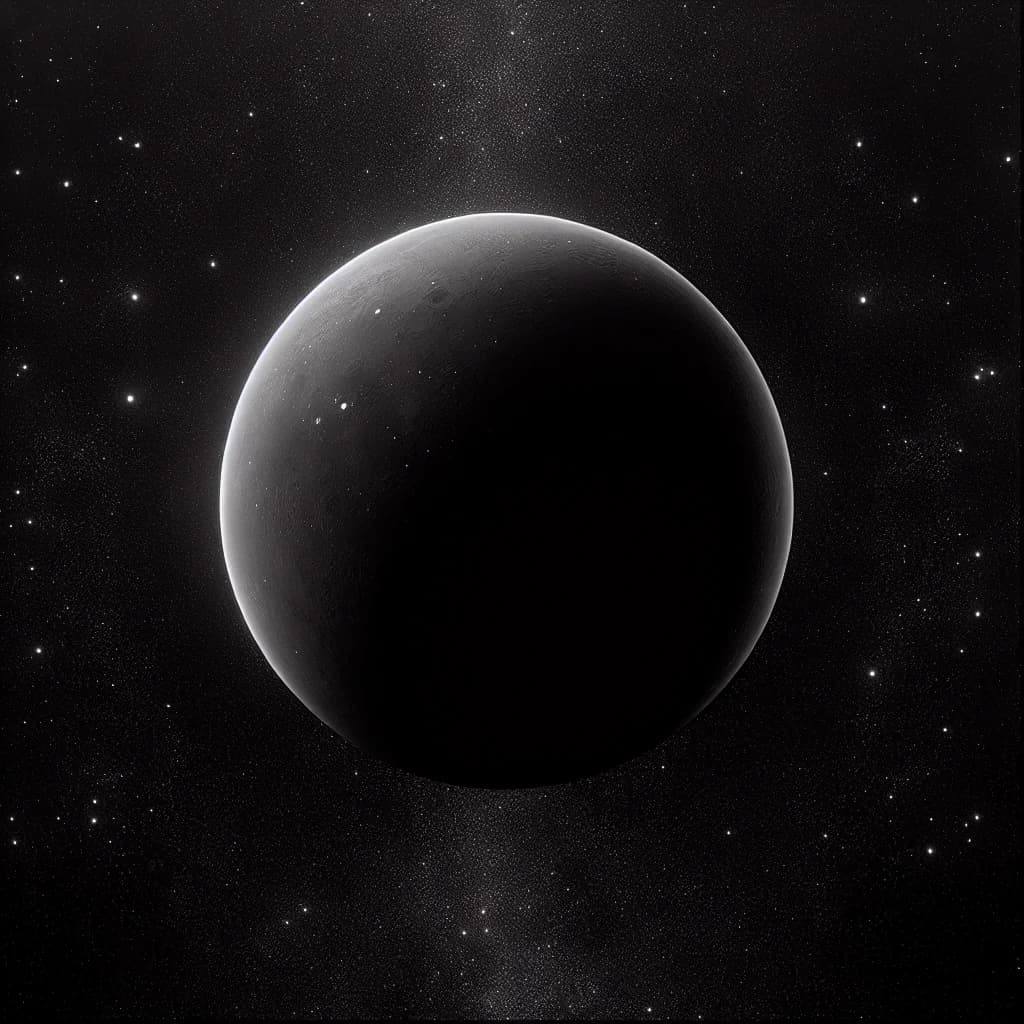
If the Moon were a perfect mirror, it would reflect the empty darkness of space instead of scattering sunlight in all directions. Aside from a tiny, blindingly bright reflection of the Sun, the Moon’s surface would become indistinguishable from the black night sky.
The Mirror Moon Mystery: Why Would a Reflective Lunar Surface Actually Look Pitch Black?
Imagine glancing up at the night sky, expecting the familiar, comforting glow of the Full Moon, only to find a circular void of absolute darkness—as if a hole had been punched through the stars. This isn't the plot of a science fiction novel; it is the logical scientific result of a fascinating thought experiment. What if we replaced the Moon’s dusty, grey regolith with a perfectly smooth, silvered mirror? While your intuition might suggest the Moon would become a brilliant beacon of light, the laws of physics dictate a much more mysterious outcome. By applying the principles of geometric optics and specular reflection, we can uncover why a "Mirror Moon" would, for the most part, appear completely black to an observer on Earth.
Diffuse vs. Specular Reflection: Why the Real Moon Glows
To understand why a mirror Moon would look black, we first have to understand why the current Moon looks bright. The Moon’s surface is composed of jagged rocks and fine dust that act as a diffuse reflector. When sunlight hits the Moon, the rough surface scatters those light rays in every possible direction. No matter where you are standing on the nighttime side of Earth, some of those scattered rays reach your eyes.
In our hypothetical scenario, we replace this rough surface with a specular reflector—a perfect mirror. A mirror does not scatter light; it reflects it at an exact angle. According to the Law of Reflection, the angle of incidence equals the angle of reflection. This means that instead of the Moon "sharing" sunlight with the entire hemisphere of Earth, it would only send light to very specific, narrow locations.
The Geometry of a Giant Convex Mirror
The Moon is a sphere with a radius of approximately 1,737 kilometers. In optics, a spherical mirror is known as a convex mirror. When light from a distant source like the Sun hits a convex mirror, the reflected rays diverge.
If you were to look at a Mirror Moon, you wouldn't see the whole surface glowing. Instead, you would see a single, tiny, incredibly bright point of light—a virtual image of the Sun.
- The Scale of the Image: While the Sun is massive (1.4 million kilometers in diameter), it is very far away. On the curved surface of a Mirror Moon, the reflection of the Sun would occupy a surprisingly small area.
- The Point Source: From your perspective on Earth, this reflection would look like a brilliant star, roughly 1/10th the apparent size of the actual Sun, but it would be concentrated into a singular "glint."
Why the Rest of the Moon Disappears
If one tiny spot is reflecting the Sun, what is the rest of the Moon reflecting? This is the key to the "Black Moon" phenomenon.
Because a mirror only shows what is positioned at the correct reflective angle, the remainder of the lunar surface would be reflecting the rest of the universe. In the vastness of space, "the rest of the universe" is mostly empty, dark vacuum.
- Reflecting the Void: The vast majority of the Mirror Moon’s surface would be angled to reflect the deep, black backdrop of interstellar space.
- The Absence of Scatter: Because there is no dust to catch and scatter light, there is no "lunar glow." Without scattered light, the edges of the Moon would be indistinguishable from the black sky behind it.
- The Earthshine Exception: Occasionally, you might see a tiny, distorted reflection of the Earth (an "Earth-rise" in the mirror), but for most of the lunar cycle, the Moon would simply look like a circular "hole" in the starfield.
The Consequences of a Darker Night
Replacing the Moon with a mirror would have significant environmental impacts due to the loss of diffuse light:
- Zero Moonlight: Currently, a Full Moon provides about 0.05–0.1 lux of illumination, enough to see your surroundings in a rural area. A Mirror Moon would provide zero ambient light, making nights on Earth significantly darker.
- The "Searchlight" Effect: While the night would be darker overall, if you happened to be in the direct path of the Sun’s reflection (the "glint"), that single point of light would be intensely bright—potentially 1/4 as bright as the Sun itself—though it would only pass over a specific location for a brief moment as the Earth rotates.
Conclusion
The transformation of the Moon into a giant mirror reveals a counterintuitive truth about light: visibility requires scattering. If the Moon were a perfect mirror, it would cease to be the "lamp" of our night sky and instead become a dark, celestial window reflecting the infinite shadows of the cosmos. We would lose the familiar "Man in the Moon" and gain a haunting, black orb that only occasionally flashes with the brilliance of a reflected sun. This thought experiment highlights how the "imperfections" of the Moon’s dusty, rocky surface are exactly what allow it to brighten our world, reminding us that even in physics, beauty often lies in the rough edges.