Why would the oceans migrate toward the poles and leave the equator dry if Earth stopped spinning entirely
Imagine a world where the equator is a bone-dry wasteland and the poles are buried under miles of rising water. Without the centrifugal force of Earth’s spin to hold them in place, the oceans would undergo a massive, gravity-driven migration that would permanently redraw the map of our planet.

Too Long; Didn't Read
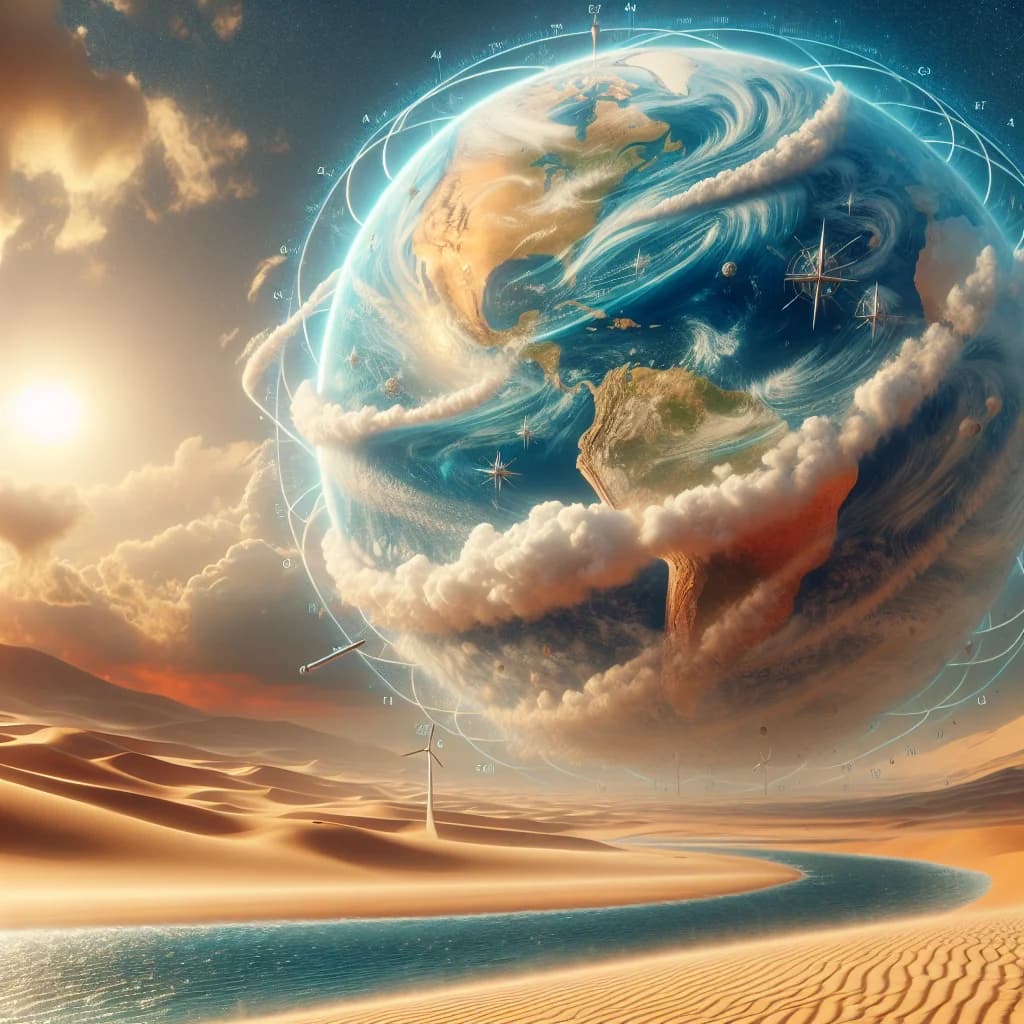
Without rotation, the centrifugal force that currently pulls water toward the equator would vanish. Gravity would then become the dominant force, dragging the oceans toward the poles where the Earth is flatter and closer to its center of mass, resulting in two massive polar oceans and a single giant continent encircling the equator.
The Great Oceanic Migration: Why Would the Seas Flee to the Poles if Earth Stopped Spinning?
Have you ever considered that the only thing keeping the Caribbean from becoming a dusty canyon is the fact that our planet is spinning at 1,000 miles per hour? It sounds like the premise of a high-concept science fiction novel, but the relationship between Earth’s rotation and its oceans is a masterclass in planetary physics. If Earth were to gradually roll to a complete stop, the world map wouldn’t just change; it would be completely inverted.
To understand this hypothetical "Big Stop," we must look at the Earth through the lenses of geodesy (the study of Earth's shape) and fluid dynamics. By removing centrifugal force from the planetary equation, we can predict a massive migration of water that would leave the equator high and dry while drowning the poles under thousands of meters of new ocean.
The Shape of a Spinning World: The Oblate Spheroid
To understand why the water moves, we first have to recognize that the Earth is not a perfect sphere. Because it spins, it acts like a piece of pizza dough being tossed in the air—it flattens slightly. This creates an equatorial bulge.
The Earth’s radius at the equator is about 21 kilometers (13 miles) larger than its radius at the poles. This "extra" height is maintained by centrifugal force. While the solid crust of the Earth is rigid and maintains this shape, the liquid oceans are far more compliant. Currently, the oceans "pile up" around the equator, held in place by the outward throw of Earth’s rotation.
The Disappearing Act: Centrifugal Force vs. Gravity
If the Earth stopped spinning, the centrifugal force would vanish. Suddenly, the only major force acting on the oceans would be gravity.
Gravity wants to pull everything toward the Earth's center of mass as efficiently as possible. Because the Earth is squashed, the "closest" points to the center of the Earth are the North and South Poles. Conversely, the "highest" points—the ones furthest from the center—are along the equator.
- The Redistribution: Without rotation to hold the water at the equator, gravity would begin pulling the oceans toward the poles.
- The Scale of Change: The 21-kilometer equatorial bulge is significantly larger than the average depth of the ocean (which is only about 4 kilometers).
- The Result: The water would completely drain away from the tropical regions and accumulate in two massive polar basins.
A New Global Geography
The physical transformation would be staggering. As the water migrates, the world would effectively be divided into three distinct zones:
1. The Equatorial Mega-Continent
As the water recedes, the seafloor would be exposed. A continuous band of land would emerge around the center of the planet. Places like Indonesia, Brazil, and Africa would no longer be separated by water but would be part of a single, massive terrestrial ring. In this scenario, the "highest" mountains on Earth would effectively be located at the equator, not because they grew, but because the sea level dropped by kilometers.
2. The Northern and Southern Circumpolar Oceans
The migrated water would collect into two isolated polar oceans.
- The Northern Ocean: This would submerge vast swaths of North America, Europe, and Northern Asia.
- The Southern Ocean: This would cover much of the southern tips of South America and Australia, surrounding a much deeper, water-shrouded Antarctica.
The Atmospheric Aftermath
The migration wouldn't just affect the water; it would affect the air. Our atmosphere is also "bulged" at the equator due to rotation. If the spin stopped, the air would migrate toward the poles along with the water. The new equatorial mega-continent would likely have a very thin atmosphere, similar to the air at the top of Mt. Everest, while the polar regions would experience much higher atmospheric pressures.
Conclusion
The ultimate outcome of a non-spinning Earth is a planet of extremes: a giant, high-altitude desert ring at the equator and two deep, pressurized oceans at the poles. This scenario highlights the delicate balance of hydrostatic equilibrium—the tug-of-war between the outward push of inertia and the inward pull of gravity.
While the Earth isn't going to stop spinning anytime soon, this thought experiment serves as a powerful reminder of how rotation dictates almost every physical aspect of our lives. We often think of the ground beneath our feet as "solid," but on a planetary scale, the Earth is a dynamic, fluid system held in a beautiful, spinning balance.