Why would throwing a massive amount of water onto the Sun cause it to burn hotter instead of extinguishing
Think dousing the Sun with water would put it out? In a cosmic twist of physics, adding water actually provides more fuel for nuclear fusion, turning our star into a much hotter and more volatile inferno.

Too Long; Didn't Read
The Sun is powered by nuclear fusion, not chemical combustion. Adding massive amounts of water increases the Sun's mass and gravitational pressure, which accelerates the fusion process and causes the star to burn significantly hotter and brighter.
The Great Solar Splash: Why Dousing the Sun with Water Would Only Fan the Flames
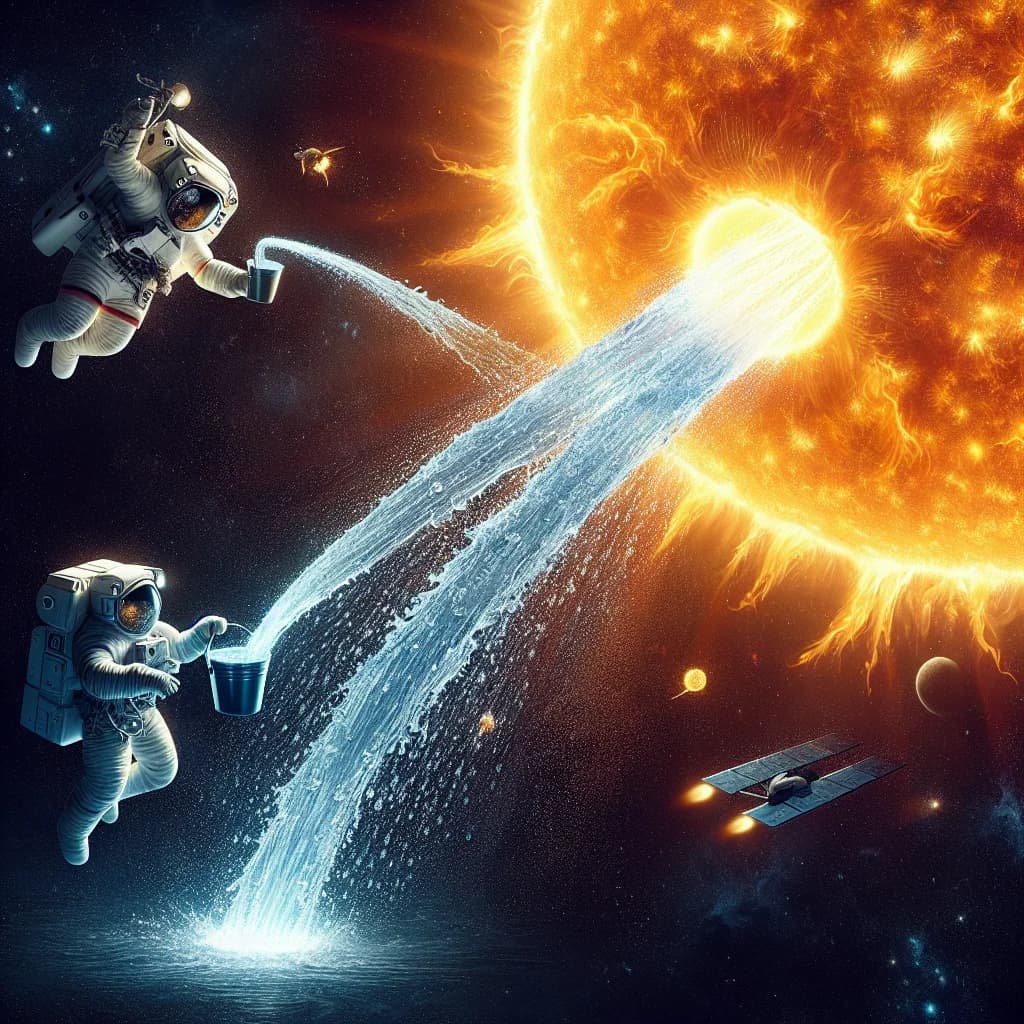
Imagine, for a moment, an interstellar bucket brigade of impossible proportions. Your mission is to extinguish the Sun by dumping a volume of water equal to the Sun’s own massive bulk directly onto its glowing surface. On Earth, water is the ultimate enemy of fire; it smothers flames and absorbs heat. Naturally, you might expect a hiss, a cloud of steam, and a cold, dark solar system. However, the laws of stellar physics have a counterintuitive surprise in store. Instead of a cosmic "clink," your efforts would result in a terrifyingly brilliant "boom." To understand why this happens, we must look beyond the chemistry of a campfire and into the high-pressure world of nuclear fusion and gravitational collapse.
Fire vs. Fusion: A Case of Mistaken Identity
The primary reason our intuition fails is that we often mistake the Sun for a giant ball of fire. On Earth, fire is a chemical reaction called combustion, which requires fuel (like wood), heat, and oxygen. Water extinguishes these flames by removing the heat and cutting off the oxygen supply.
The Sun, however, is not "on fire." It is a massive nuclear reactor powered by gravity. It doesn't "burn" fuel in the traditional sense; it fuses atoms together. Because the Sun is held together by its own immense gravity, adding more material—even a cooling substance like water—does not dampen the reaction. Instead, it adds to the total mass of the star, which is the one thing a star craves most to grow hotter.
The Gravity of the Situation: Mass Equals Heat
In the realm of astrophysics, mass is destiny. The Sun contains approximately $1.989 \times 10^{30}$ kilograms of matter. If you were to dump an equal mass of water onto it, you would effectively double the Sun's mass.
- Increased Compression: Adding this massive amount of water increases the Sun’s gravitational pull. This extra weight crushes the solar core with even more intensity than before.
- The Pressure Spike: As the core is squeezed, the pressure and temperature skyrocket. In stellar physics, higher pressure leads directly to a higher rate of nuclear fusion.
- Luminosity Boost: Because fusion rates increase exponentially with temperature, doubling the mass doesn't just double the heat; it could make the star shine many times brighter than it does now.
Breaking Down the Water: Adding Fuel to the Nuclear Fire
Water ($H_2O$) consists of two hydrogen atoms and one oxygen atom. To the Sun, this isn't "water"—it’s a delivery of high-grade fuel and a catalyst.
1. The Hydrogen Buffet
Hydrogen is the primary fuel for the Sun’s proton-proton chain reaction. By adding a massive amount of water, you are essentially handing the Sun a fresh supply of hydrogen. This increases the total amount of "fuel" available for fusion, extending the potential life of the star but causing it to burn much more violently in the short term.
2. The Oxygen Catalyst
While our Sun currently fuses hydrogen into helium, more massive stars use something called the CNO (Carbon-Nitrogen-Oxygen) cycle. By introducing a massive amount of oxygen from the water, you facilitate this much more efficient and hotter fusion process. The oxygen acts as a catalyst, allowing the star to convert hydrogen into energy at a blistering pace.
The Result: A New Kind of Star
If you successfully "doused" the Sun with a Sun-sized ocean, you wouldn't be left with a wet ball of steam. Instead, you would create a "Blue Giant."
- Color Shift: The Sun would transition from its current yellow-white hue to a brilliant, piercing blue-white.
- Temperature Increase: Surface temperatures would soar far beyond the current 5,500 degrees Celsius.
- Radiation Output: The "Solar Splash" would result in a massive increase in ultraviolet and X-ray radiation, drastically altering the light environment of the solar system.
Conclusion
The thought experiment of "watering" the Sun reveals a fundamental truth about our universe: the rules of the very large are often the opposite of the rules of the very small. While a cup of water is a death sentence for a candle flame, a solar-system-sized ocean is a power-up for a star. This outcome is dictated by the relentless force of gravity and the mechanics of nuclear fusion, which turn any additional mass into a source of heat and light. It serves as a fascinating reminder that in the vacuum of space, mass is the ultimate currency, and the Sun is an account that only knows how to grow.