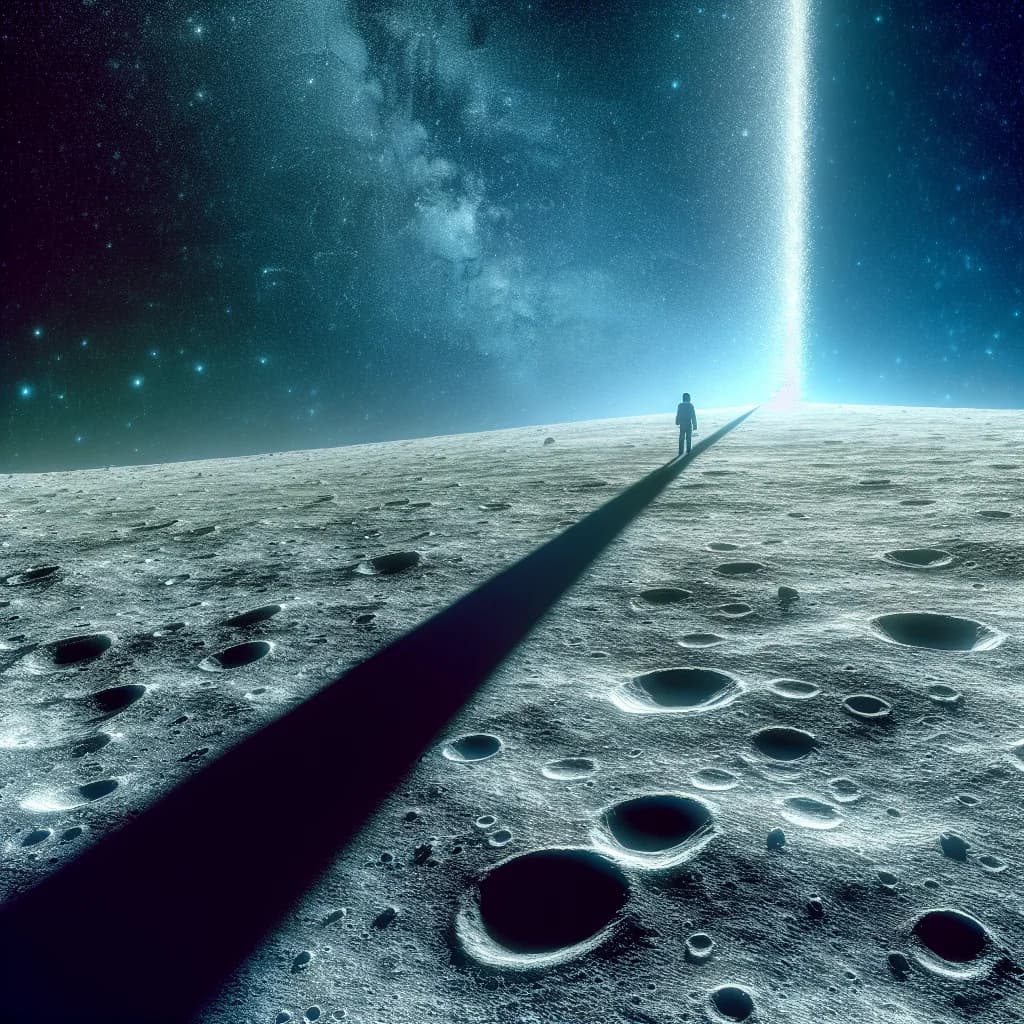
Why would you freeze to death while surrounded by a million-degree gas cloud in deep space
It sounds like a cosmic paradox, but floating in a million-degree gas cloud would actually leave you frozen solid. Discover the mind-bending physics of why "temperature" doesn't always mean "heat" in the lethal vacuum of space.


Too Long; Didn't Read
The gas is so thin that there are not enough particles to transfer heat to your body through conduction. Even though individual atoms move at high speeds, you would lose heat through radiation much faster than you could gain it from the sparse gas, causing you to freeze.
The Million-Degree Paradox: Why You’d Freeze in the Hottest Clouds of Space
Imagine floating in a celestial cloud glowing with a staggering temperature of one million degrees Celsius. In any earthly context, this would be an instantaneous vaporizing event. However, in the vast reaches of deep space, this scenario presents a counterintuitive reality: despite being surrounded by "million-degree" gas, you would slowly lose your body heat until you froze solid. This cosmic magic trick isn't a flaw in physics, but rather a fascinating demonstration of how the universe handles energy. To understand this paradox, we must look at the distinct roles of thermodynamics, kinetic theory, and the extreme vacuum of the interstellar medium.
Temperature vs. Heat: The Invisible Distinction
The first step in solving this puzzle is separating the concept of temperature from the concept of heat. While we often use these terms interchangeably, they describe very different physical properties:
- Temperature is a measurement of the average kinetic energy (speed) of individual particles in a substance. In a million-degree gas cloud, the atoms are moving at incredible velocities—thousands of kilometers per second.
- Heat, however, is the total energy transferred from one object to another. This depends not just on how fast the particles are moving, but on how many of them there are (density).
In a laboratory on Earth, a million-degree plasma would be incredibly dense and packed with energy. But in deep space, "million-degree gas" is often spread so thin that it is effectively a vacuum.
The Ghostly Furnace: Density Matters
The primary reason you would freeze is the sheer emptiness of the space around you. To feel "hot," you need particles to collide with your skin and transfer their energy to you.
Consider these comparisons of particle density:
- Earth’s Atmosphere: At sea level, there are approximately $2.5 \times 10^{25}$ (25 septillion) molecules in every cubic meter of air.
- A "Hot" Interstellar Cloud: These regions might contain only one atom per cubic centimeter, or even fewer.
Even though those few atoms are zooming around with "million-degree" energy, there are so few of them that they rarely ever hit you. It would be like being in a massive stadium where only one person is throwing a single, tiny, high-speed pebble at you every hour. The pebble has a lot of energy, but it isn't enough to keep you warm.
The Three Ways Heat Moves (Or Fails to Move)
In physics, heat is transferred via three methods: conduction, convection, and radiation. In the vacuum of a hot gas cloud, the first two essentially disappear.
Conduction and Convection
These methods require a medium—solid, liquid, or gas—to move energy. Because the gas cloud is so sparse, there is no meaningful conduction (direct contact) or convection (fluid movement) to bring that million-degree energy into your body.
Thermal Radiation: Your Personal Cooling System
This is the "tipping point" of the experiment. Your body is a warm object, typically maintained at about 37°C (310 Kelvin). According to the Stefan-Boltzmann Law, any object with a temperature above absolute zero emits energy in the form of electromagnetic radiation (mostly infrared for humans).
Because the surrounding gas cloud is too thin to transfer heat to you, your body continues to radiate its own heat away into the void. Without an incoming supply of energy to replace what you are radiating out, your internal temperature will steadily drop.
The Calculation of Cold
If we treat a human as a "black body" (an idealized physical body that absorbs all incident electromagnetic radiation), we can estimate the rate of cooling. In a perfect vacuum, a human might lose heat at a rate of roughly 1,000 watts. Since the "million-degree" particles are too few to provide even a fraction of a watt of incoming energy, the net energy loss is almost total.
You become a biological radiator, glowing in the infrared spectrum as you shed your thermal energy into the vastness of space.
Conclusion
The scientific reality of the million-degree gas cloud serves as a profound reminder that the universe is governed by scale and density. You would freeze not because the temperature is low, but because the "heat" is spread too thin to reach you. This scenario illustrates the core principles of the Kinetic Theory of Matter: motion is temperature, but contact is energy transfer.
While the idea of a freezing million-degree cloud feels like a contradiction, it highlights the elegant complexity of thermodynamics. It reminds us that our Earthly experiences with heat—steam from a kettle or the warmth of a bonfire—are only possible because we live in a wonderfully dense corner of the cosmos. In the grander scale of the universe, density is truly destiny.