Why would your blood appear emerald green if you were cut while diving deep underwater
At extreme depths, the ocean hides a surreal secret: cut yourself, and you won't bleed red, but a haunting shade of alien emerald. Discover the mind-bending physics of light that transforms your biology into something truly otherworldly beneath the waves.

Too Long; Didn't Read
At significant depths, water absorbs red light, which is the first color to disappear from the visible spectrum. Without red light to reflect, blood appears emerald green because only shorter wavelengths like green and blue penetrate deep enough to be reflected back to your eyes.
The Emerald Transformation: Why Would Your Blood Look Green in the Deep Ocean?
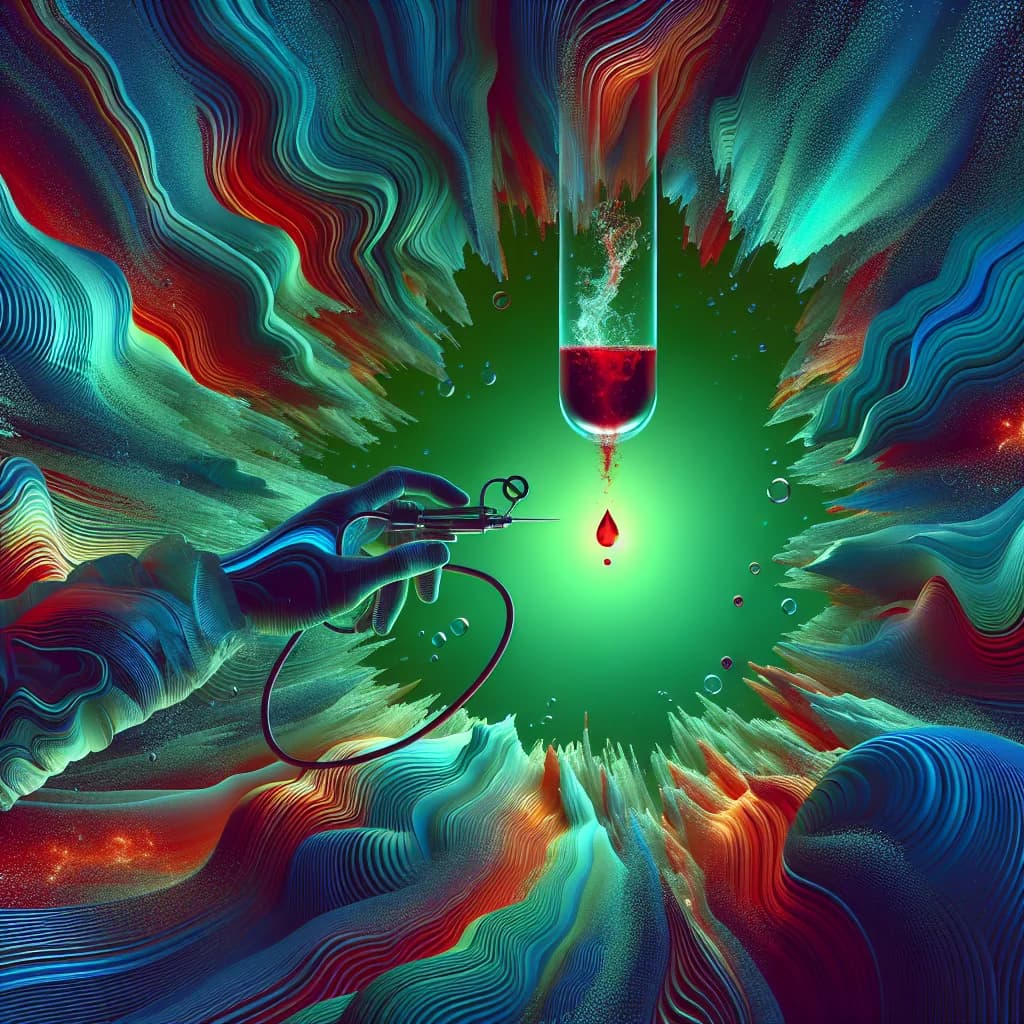
Imagine you are gliding through the twilight zone of the ocean, surrounded by the rhythmic bubbles of your regulator and the silent, heavy weight of the abyss. Suddenly, you snag your finger on a piece of equipment. Instead of the familiar crimson hue you expect, a puff of brilliant emerald green liquid begins to swirl into the water. This isn’t a scene from a science fiction movie, nor have you suddenly transformed into an extraterrestrial. You are simply witnessing a fascinating demonstration of optical physics and the selective filtering of the electromagnetic spectrum.
This thought experiment explores the boundary between human biology and marine optics. To understand this phenomenon, we must analyze the scenario through the lenses of physics—specifically light attenuation and color subtraction—and the chemical properties of hemoglobin. The primary driver of this transformation is not a change in the blood itself, but a change in the light available to illuminate it.
The Electromagnetic Spectrum: A Master of Disguise
To understand why colors "change" underwater, we first have to recognize that what we perceive as color is actually reflected light. Sunlight is composed of all the colors of the rainbow: Red, Orange, Yellow, Green, Blue, Indigo, and Violet (ROYGBIV). Each of these colors travels at a different wavelength and carries a different level of energy.
- Red Light: Longest wavelength (~620–750 nm), lowest energy.
- Green Light: Medium wavelength (~495–570 nm), medium energy.
- Blue Light: Shortest wavelength (~450–495 nm), highest energy.
In the open air, sunlight hits your blood, and the hemoglobin molecules absorb almost everything except the red wavelengths, which are reflected back to your eyes. This is why, under the sun, blood is undeniably red.
The Ocean as a Giant Color Filter
When light enters the water, the liquid acts as a powerful filter. Water molecules and suspended particles absorb light at different rates based on its wavelength. This process is known as attenuation.
The Vanishing Act of Red
As you descend, the ocean systematically "steals" colors from the spectrum. Red is the very first color to disappear. Because red light has the longest wavelength and the lowest energy, it lacks the "stamina" to penetrate deep into the water.
- At 15 feet (5 meters): Red light begins to dim significantly.
- At 30 feet (9 meters): Roughly 90% of red light has been absorbed.
- At 60 feet (18 meters): Red light is virtually non-existent.
By the time you reach depths favored by many advanced recreational divers, the environment is dominated by high-energy blue and green wavelengths.
The Physics of Reflection and Subtraction
If you are at a depth of 60 feet, there is no red light left in the environment to bounce off your blood. To our eyes, an object can only appear a certain color if that color of light is present to be reflected.
When you are cut at this depth, the blood (which naturally wants to reflect red) has no red light to work with. However, blood does not only reflect red; it also reflects a tiny amount of green light. Under normal conditions, the sheer intensity of the reflected red light completely overwhelms the green. But in the deep ocean, the "mask" of red is removed. The only available light that the blood can reflect is the ambient green and blue light of the surrounding water.
Consequently, the blood absorbs the dominant blue light and reflects the remaining green wavelengths. This creates a startling "emerald green" appearance. If you were to turn on a high-powered dive light—reintroducing the full spectrum of light—the blood would instantaneously "snap" back to its natural bright red.
Environmental Consequences of Color Shifting
This phenomenon isn't just a quirk of human biology; it dictates the lives of deep-sea creatures. Many deep-sea animals are naturally red. In the deep ocean, being red is functionally the same as being invisible. Because there is no red light to reflect, these creatures appear pitch black to predators, allowing them to hide in plain sight.
In our diving scenario, the "green" blood is essentially a visual illusion caused by the absence of the red end of the spectrum. It serves as a vivid reminder that our perception of reality is entirely dependent on the physical medium through which we observe it.
Conclusion
The transformation of blood from red to emerald green at depth is a spectacular lesson in the physics of light. While the chemical composition of your hemoglobin remains unchanged, the ocean’s ability to filter out long-wavelength red light fundamentally alters how we perceive color. The core principles of light attenuation and selective reflection dictate that without red light, red objects simply cannot exist as we know them. This phenomenon connects us to the broader scientific truth that the "colors" we see in the world are not inherent properties of objects, but rather a complex dance between light, matter, and the environment. Under the waves, the ocean rewrites the rules of the rainbow, turning the familiar into the fantastic.