Would the roar of the Sun deafen everyone on Earth if the vacuum of space were replaced with air
The Sun is a non-stop nuclear explosion, and if the vacuum of space were replaced with air, its roar would be loud enough to shatter eardrums 93 million miles away. Discover why the silence of the void is the only thing protecting Earth from a permanent, deafening scream.

Too Long; Didn't Read
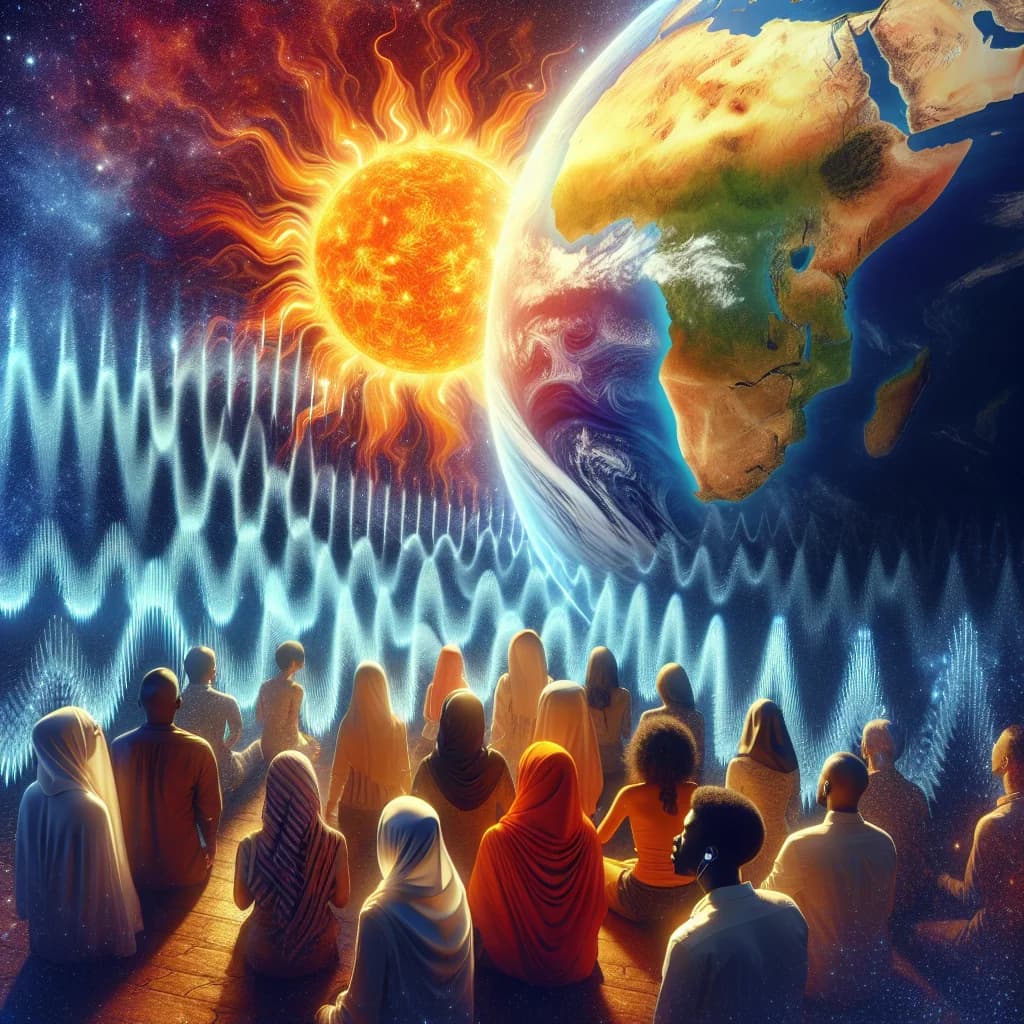
If space were filled with air, the Sun's nuclear activity would create a constant 100 to 120-decibel roar on Earth. This volume, equivalent to a rock concert or a chainsaw, would be loud enough to cause permanent hearing damage and make normal life impossible.
A Celestial Rock Concert: What Would the Sun Sound Like if Space Had Air?
We often think of the cosmos as a serene, silent void. The famous tagline for the movie Alien reminded us that "In space, no one can hear you scream," and for good reason: sound requires a medium, like air or water, to travel. But what if that cosmic vacuum were suddenly replaced with a breathable atmosphere? Specifically, what would happen if the 93 million miles between Earth and the Sun were filled with air?
This thought experiment requires us to look past the immediate gravitational consequences—such as the Sun drawing all that air into itself—and focus specifically on the acoustics. By applying the laws of physics and the principles of helioseismology, we can calculate the sheer volume of our local star. This analysis will explore the Sun’s acoustic energy, how sound diminishes over vast distances, and the surprising auditory reality we would face.
The Roar of a Trillion Storms
The Sun is not a quiet object. It is a massive, turbulent ball of plasma powered by nuclear fusion. Its surface is covered in convection cells—huge pockets of hot gas rising and falling—each roughly the size of Texas. This constant, violent motion creates massive pressure waves, essentially making the Sun a giant acoustic resonator.
Scientists estimate that the "surface" noise of the Sun is approximately 290 decibels (dB). To put that into perspective, decibels are a logarithmic scale, meaning every increase of 10 dB represents a tenfold increase in sound intensity.
- A quiet library: 30 dB
- A chainsaw: 110 dB
- A jet engine at takeoff: 140 dB (the threshold of immediate physical pain)
- A Saturn V rocket launch: 204 dB
At 290 dB, the Sun is producing a sound so intense it surpasses anything humanly achievable on Earth. It is a roar generated by millions of simultaneous "sonic booms" from convection currents moving at supersonic speeds.
The Long Walk: How Sound Travels 93 Million Miles
If the vacuum of space were replaced with a uniform atmosphere (similar to Earth's sea-level density), that 290 dB roar would have a medium to travel through. However, sound loses intensity as it spreads out from a source, a principle known as the Inverse Square Law.
As a sound wave expands, its energy is distributed over an increasingly large area. By the time the Sun’s acoustic energy traveled the 150 million kilometers (93 million miles) to reach Earth, it would have dissipated significantly.
The Calculation
Using the standard formula for sound attenuation over distance, we find that the roar of the Sun would reach Earth at approximately 100 to 110 decibels.
While 110 dB is a far cry from the 290 dB at the source, it is still incredibly loud. For comparison:
- 100 dB is equivalent to standing next to a power mower or a jackhammer.
- 110 dB is comparable to a live rock concert or a shouting match directly in your ear.
The Consequences of a Permanent Shouting Match
If the Sun "screamed" at 110 dB across the sky, the environmental and biological impact would be transformative. Unlike a concert, this sound would never stop. It would be a constant, inescapable drone that would persist 24 hours a day, regardless of whether the Sun was visible, as the sound waves would refract through our own atmosphere.
- Auditory Health: Constant exposure to 100+ dB leads to permanent hearing loss over time. Humanity would likely have evolved very differently, perhaps with specialized ear structures or a complete reliance on non-auditory communication.
- Atmospheric Friction: In a hypothetical universe where space is filled with air, the physical movement of the Earth through that medium would create immense friction. At our orbital speed of 67,000 miles per hour, the "air" would heat up significantly, likely masking the Sun's roar with the local whistle of our own supersonic travel.
- Communication Barriers: Standard verbal communication would be nearly impossible. Imagine trying to have a conversation while someone runs a leaf blower two feet away from you—forever.
Conclusion
If the silence of the vacuum were replaced by air, the Sun would no longer be a silent guardian of light; it would be a deafening neighbor. At a constant 110 decibels, the "roar" of the Sun would be loud enough to cause long-term hearing damage and fundamentally alter the way life functions on our planet.
Ultimately, this thought experiment highlights the incredible energy produced by our star. While the Sun provides the light and heat necessary for our existence, it also produces a level of noise that would be physically overwhelming if not for the protective silence of the vacuum. We can appreciate the Sun much more comfortably knowing that its violent, turbulent nature is kept "on mute" by the vast, empty reaches of space.