Why would the entire human race fit inside a sugar cube if all atomic empty space was removed
You are made of 99.9% empty space, and if you squeezed out that invisible "nothingness," the entire human race would collapse into a speck no larger than a sugar cube. Discover the mind-bending physics of why humanity is far less solid than it appears.

Too Long; Didn't Read
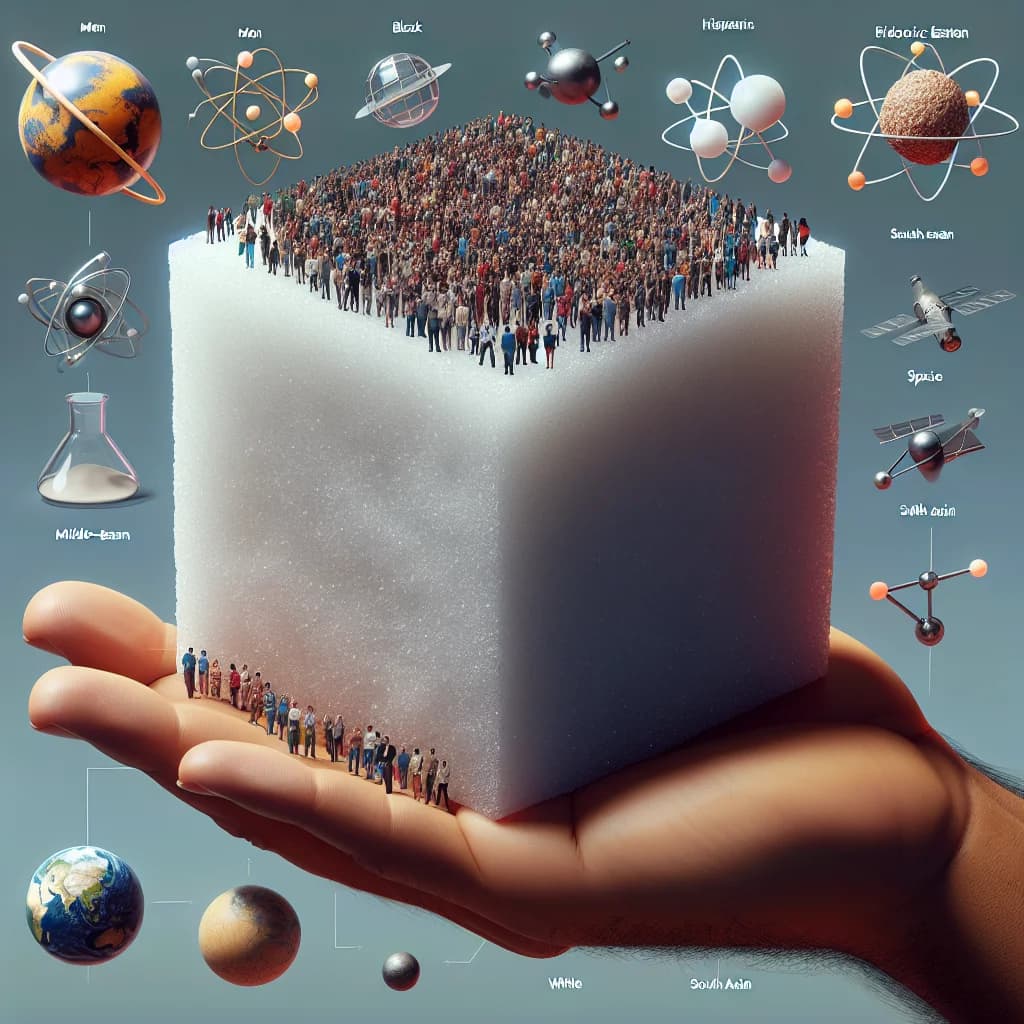
Atoms are 99.9% empty space. If you removed this vast void from every human on Earth, the remaining dense matter would shrink to the size of a sugar cube while still weighing as much as the entire global population.
The Great Cosmic Squeeze: Could the Entire Human Race Truly Fit Inside a Sugar Cube?
Imagine for a moment that you could reach into the very fabric of reality and dial down the "volume" of every atom in your body—not by removing matter, but by simply eliminating the vast stretches of nothingness within them. If we performed this cosmic downsizing on every single person on Earth, the entire human population would condense into a space no larger than a standard sugar cube. It sounds like the plot of a surrealist science fiction novel, yet it is a rigorous conclusion based on the fundamental principles of atomic physics.
This thought experiment explores the staggering discrepancy between the perceived solidity of our world and the actual distribution of matter. By applying the laws of quantum mechanics and nuclear physics, we can peel back the layers of the "empty" universe to see what we are actually made of.
The Illusion of Solidity: A Stadium and a Pea
To understand how 8 billion people could fit into a teaspoon, we must first look at the anatomy of an atom. We often visualize atoms as tiny solar systems with electrons orbiting a central nucleus like planets. However, the scale of these components is mind-boggling.
The nucleus, which contains 99.9% of an atom’s mass, is incredibly tiny compared to the overall size of the atom itself. If an atom were expanded to the size of a massive professional football stadium, the nucleus would be roughly the size of a small pea sitting on the 50-yard line. The electrons would be like tiny gnats buzzing around the very highest seats in the stands. Everything in between—the field, the bleachers, the air—is essentially empty space.
Calculating the Human "Crumple Zone"
If we theoretically "removed" that empty space, we would be left with only the dense nuclei and electrons. Let’s look at the math behind this staggering compression:
- The Mass of Humanity: The average weight of a human is approximately 62 kilograms (136 lbs). With a global population of roughly 8 billion, the total mass of the human race is about 496 million metric tonnes.
- The Density of Nuclear Matter: Nuclear matter is unimaginably dense. A single cubic centimeter of pure nuclear material (the density found in a neutron star) weighs approximately 100 million tonnes.
- The Final Volume: If you take the total mass of humanity (roughly 500 million tonnes) and compress it to nuclear density, you end up with a volume of approximately 5 cubic centimeters.
While a standard sugar cube is about 1 cubic centimeter, the comparison remains valid in its spirit: the entire weight of our species would occupy a space roughly the size of a few sugar cubes or a large marble.
Why Don't We Just Collapse?
If we are 99.9999999% empty space, why can’t we walk through walls or compress ourselves at will? The answer lies in the Pauli Exclusion Principle and electromagnetic repulsion.
Electrons are negatively charged. When you sit in a chair, the electrons in your atoms and the electrons in the chair’s atoms repel each other like the same poles of two magnets. You aren't actually "touching" the chair; you are hovering a microscopic distance above it, held up by the invisible force of electromagnetism. It is this energetic "buffer" that gives the world its illusion of solidity and keeps our "empty" atoms from collapsing.
The Consequences of a "Human Cube"
While our hypothetical sugar cube would be small, it would behave in extraordinary ways due to its extreme density.
- Extreme Weight: This cube would weigh 500 million tonnes. If you placed it on a table, or even on the surface of the Earth, the pressure would be so immense that it would instantly slice through the ground like a hot knife through butter, plummeting toward the Earth's core.
- Gravitational Pull: While the cube wouldn't be a black hole (it lacks the necessary mass), it would have a noticeable local gravitational pull. Standing near it, you would feel a slight tug toward the cube, though it would be vastly overshadowed by the Earth's own gravity.
Conclusion
The realization that the entire human race could fit within the dimensions of a sugar cube serves as a profound reminder of the strange nature of our universe. We are, quite literally, mostly made of nothing. Our physical presence, our buildings, and our mountains are defined not by the "stuff" they contain, but by the energetic forces that hold that empty space open.
By stripping away the voids, we reveal the core reality of matter: it is incredibly dense, incredibly rare, and governed by invisible laws that ensure our world feels solid. This thought experiment connects the colossal scale of our daily lives to the microscopic mysteries of the quantum realm, proving that in physics, size is often an illusion.