Why would the extreme gravity of a neutron star allow you to see its entire surface from one side
Imagine a world where you can see the back of a star while looking directly at its front. Discover how the reality-warping gravity of a neutron star bends light so violently that it reveals the entire surface from a single, mind-bending perspective.

Too Long; Didn't Read
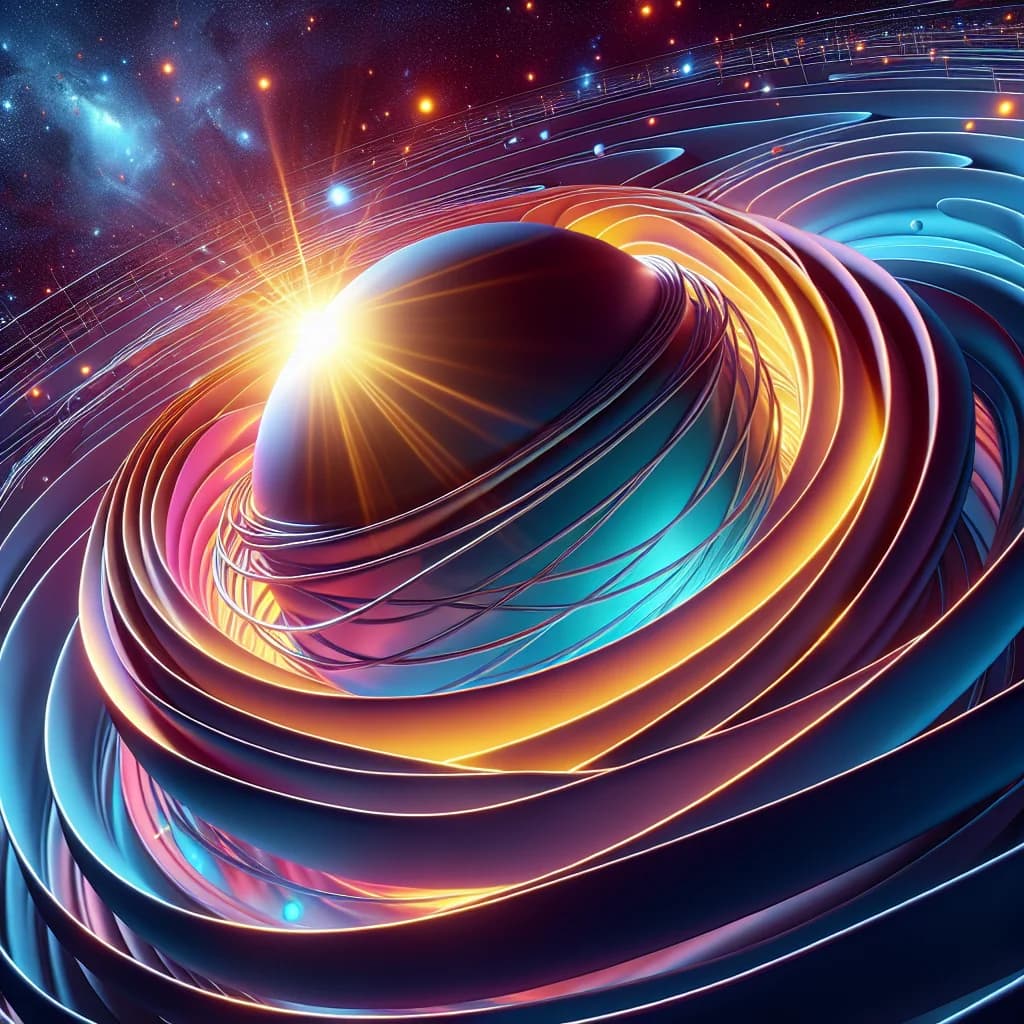
Neutron stars possess such immense gravity that they warp spacetime, causing light from their far side to bend around the star and reach the observer. This gravitational lensing effect effectively stretches the visible horizon, allowing you to see the entire surface simultaneously from a single perspective.
Could You See the Back of a Star? How Extreme Gravity Reveals the Hidden Sides of a Neutron Star
Imagine standing before a sphere so dense and powerful that it breaks the very rules of perspective. Normally, when you look at a ball, the horizon hides exactly half of its surface from your view. However, in the high-stakes environment of deep space, the rules of geometry undergo a radical transformation. Neutron stars—the collapsed cores of massive suns—possess gravity so intense that they act like a cosmic hall of mirrors. If you were to hover at a safe distance from one, you wouldn't just see the "front" of the star; you would see the sides, the poles, and even a significant portion of the far side, all at once. This mind-bending visual occurs because neutron stars don’t just pull on matter; they warp the very fabric of spacetime, forcing light to travel in circles.
The Ultimate Heavyweight: Understanding Neutron Star Density
To understand why light behaves so strangely near a neutron star, we must first look at the sheer scale of the star’s mass. A neutron star is essentially a giant atomic nucleus. It contains roughly 1.4 to 2 times the mass of our Sun, yet it is compressed into a sphere only about 12 miles (20 kilometers) in diameter—roughly the size of a small city.
To put this density into perspective:
- The Weight of a Teaspoon: A single teaspoon of neutron star material would weigh approximately 1 billion tons. That is equivalent to the weight of the entire human population several times over, or about 3,000 Empire State Buildings.
- Surface Gravity: The gravity on a neutron star is roughly 200 billion times stronger than Earth's. If you dropped an object from just one meter above the surface, it would hit the ground at speeds of millions of miles per hour.
Because the mass is so concentrated, the gravitational field is powerful enough to influence the behavior of photons (light particles), which usually travel in straight lines.
Spacetime: The Curved Highway of Light
In our everyday lives, we assume light travels in a straight path. However, Albert Einstein’s General Theory of Relativity explains that gravity is actually the curvature of "spacetime." Think of spacetime as a trampoline. If you place a bowling ball in the center, the fabric curves. Any marble (light) rolling past the ball will follow that curve.
Near a neutron star, the "dent" in spacetime is so deep that the path of light becomes significantly distorted. This phenomenon is known as gravitational lensing. When light leaves the "back" or the "sides" of the neutron star, instead of heading off into the void of space, the extreme gravity tugs on the light beams, bending them around the curvature of the star and redirecting them toward your eyes.
The Visual Result: A Star That Unwraps Itself
Because of this extreme bending, an observer looking at a neutron star sees a distorted image that covers much more than 50% of the surface. In fact, depending on the mass and compactness of the star, you could theoretically see up to 30% more of the surface than a standard sphere would allow, and in extreme cases, the entire surface becomes visible.
Key Effects of Gravitational Lensing:
- Surface Expansion: The star appears larger than its physical dimensions because the light from the edges is being bent outward toward the observer.
- The "Wraparound" Effect: Features on the far side of the star—such as "hot spots" caused by magnetic activity—appear as rings or halos around the visible disk.
- Magnification: The gravity acts as a natural magnifying glass, brightening the light emitted from the star’s surface.
Why This Matters for Science
This isn't just a fun optical illusion; it is a vital tool for astrophysicists. By studying how much of the star we can see, scientists can calculate the "compactness" of the star (the ratio of its mass to its radius). This helps researchers understand the "Equation of State," which describes how matter behaves under the most extreme pressures in the universe—pressures so high that atoms themselves collapse.
Conclusion
The ability to see the "hidden" side of a neutron star is a spectacular demonstration of General Relativity in action. It proves that gravity is not just a force that keeps our feet on the ground, but a fundamental architect of how we perceive the universe. By bending light, neutron stars allow us to peek around corners and witness the true, warped nature of spacetime. While we may never stand near one of these exotic remnants, they remind us that the universe is far more complex and visually dazzling than our terrestrial perspective suggests, turning the simple act of "seeing" into a journey through the heart of physics.